Glucose-insulin dynamics in DIS_DIAB (Hong 2013)
Source:vignettes/articles/Hong_2013_glucose_insulin.Rmd
Hong_2013_glucose_insulin.RmdModel and source
- Citation: Hong Y, Dingemanse J, Sidharta P, Mager DE. Population Pharmacodynamic Modeling of Hyperglycemic Clamp and Meal Tolerance Tests in Patients with Type 2 Diabetes Mellitus. The AAPS Journal 2013;15(4):1051-1063.
- DOI: https://doi.org/10.1208/s12248-013-9512-4
- PubMed: PMID 23913136; PMCID PMC3787234.
Hong 2013 develops an integrated population PD model of glucose and insulin homeostasis in 20 adults with type 2 diabetes mellitus (DIS_DIAB) under two perturbation conditions:
- Hyperglycemic glucose clamp (HGC) – intravenous glucose loading dose plus Biostator-controlled infusion clamping blood glucose at 240 mg/dL for 120 min.
- Meal tolerance test (MTT) – standardised oral breakfast (approximately 618 kcal) after an overnight fast, observed for 4 h.
The paper extends the Silber 2007 integrated glucose-insulin framework with two modifications:
- Endogenous glucose production GP is constant (the feedback term that Silber estimated was close to zero in DIS_DIAB).
- The HGC first-phase insulin response is captured by an empirical
Gaussian secretion pulse (amplitude
Amplitude, peak timeTsecfixed at 3.54 min, widthTdurfixed at 1.76 min) rather than a NONMEM bolus.
Palosuran 125 mg b.i.d. was the investigational drug; the paper concludes it has no clinically meaningful effect on insulin secretion or sensitivity, so the published final estimates fix the palosuran effect to zero and the structural model is essentially a drug-free glucose-insulin homeostasis model in DIS_DIAB.
The paper produces two distinct dynamical systems (HGC and MTT) that
share the glucose-disposition and effect-compartment structure but
differ in the glucose input arm (IV clamp vs. transit-absorbed meal) and
the insulin secretion equation (biphasic Gaussian + linear vs. power +
incretin Emax). Following the package’s convention of replicating the
authors’ model structure, this paper contributes two model files
(Hong_2013_glucose_insulin_HGC.R and
Hong_2013_glucose_insulin_MTT.R) and one shared vignette
(this article).
Population
The model was fit to 20 adults with DIS_DIAB treated by diet only (16 male, 4 female; mean age 53.7 y, range 40-65; fasting blood glucose 110-180 mg/dL; HbA1c 5.4-8.3%, mean 6.4%). The study was a double-blind, placebo-controlled, randomised, two-way crossover trial of palosuran 125 mg b.i.d. for 4 weeks against placebo with a 4-week washout (Ethikkommission der Aerztekammer Nordrhein, Germany). MTT was performed on day 28 and HGC on day 29 of each treatment period.
Source trace
The per-parameter origin is recorded in the in-file comments next to
each ini() entry in
inst/modeldb/endogenous/Hong_2013_glucose_insulin_HGC.R and
Hong_2013_glucose_insulin_MTT.R. The tables below collect
them in one place.
HGC model (Table I)
| Parameter | Value | Source location |
|---|---|---|
| Eq. 1 | dG/dt structural | Hong 2013, p. 1053, Eq. 1 |
| Eq. 2 | dI/dt structural | Hong 2013, p. 1053, Eq. 2 |
| Eq. 3 | dICE/dt structural | Hong 2013, p. 1053, Eq. 3 |
CLG |
0.164 L/min | Table I |
CLGI_HGC |
0.0111 L/min/(mU/L) | Table I |
VG |
23.7 L | Table I |
gamma |
0.000431 mU/(min^2*(mg/L)) | Table I |
Amplitude |
32.2 mU | Table I |
CLI |
1.54 L/min | Table I |
VI |
6.09 L (FIXED, Silber 2007 DIS_DIAB lit) | Table I footnote a |
kIE |
0.00291 1/min | Table I |
Tsec |
3.54 min (FIXED, lit value ref 16) | Hong 2013 Results section |
Tdur |
1.76 min (FIXED, lit value ref 16) | Hong 2013 Results section |
propSd_Gc |
10.3% (proportional in linear space) | Table I residual error sigma_G_HGC |
propSd_Ic |
25.7% (proportional in linear space) | Table I residual error sigma_I_HGC |
MTT model (Table II)
| Parameter | Value | Source location |
|---|---|---|
| Eq. 4 | dG/dt with transit-absorption input | Hong 2013, p. 1055, Eq. 4 |
| Eq. 5 | ABSG = Savic analytical transit form | Hong 2013, p. 1055, Eq. 5 |
| Eq. 6 | IR_MTT = power x incretin Emax | Hong 2013, p. 1055, Eq. 6 |
n |
0.781 | Table II |
MTT |
62.5 min | Table II |
BIO |
0.252 | Table II |
CLGI_MTT |
0.00425 L/min/(mU/L) | Table II |
Emax |
2.02 | Table II |
ABSG50 |
14.8 mg/min (FIXED, Jauslin 2007) | Table II footnote a |
IPRG |
3.06 | Table II |
CLG / VG |
FIXED from HGC | Hong 2013 Results section (carried from HGC Table I) |
CLI / VI / kIE |
FIXED from HGC | Hong 2013 Results section (carried from HGC Table I) |
propSd_Gc |
7.02% (proportional in linear space) | Table II residual error sigma_G_MTT |
propSd_Ic |
30.2% (proportional in linear space) | Table II residual error sigma_I_MTT |
Dimensional analysis
Both models use glucose as a state holding glucose
amount in mg, insulin as a state holding
insulin amount in mU, and effect as a
state holding effect-compartment insulin concentration
in mU/L. With time in min, the right-hand sides of every
ODE must reduce to (state units)/min.
| ODE term | Units | Calculation |
|---|---|---|
gp = GCss * (CLG + CLGI_HGC * ICss) |
mg/min | (mg/L) * (L/min + L/min/(mU/L) * mU/L) = (mg/L) * (L/min) = mg/min |
(CLG / VG) * glucose |
mg/min | (L/min / L) * mg = (1/min) * mg = mg/min |
(CLGI_HGC / VG) * glucose * effect |
mg/min | (L/min/(mU/L) / L) * mg * (mU/L) = (1/min/(mU/L)) * mg * (mU/L) = mg/min |
ir_base = ICss * CLI |
mU/min | (mU/L) * (L/min) = mU/min |
Gaussian ir_first
|
mU/min | mU / min (Amplitude in mU, Tdur in min) |
Linear ir_second = gamma * t * delta_g
|
mU/min | mU/(min^2(mg/L)) min * (mg/L) = mU/min |
(CLI / VI) * insulin |
mU/min | (L/min / L) * mU = mU/min |
kie * (insulin/VI - effect) |
(mU/L)/min | (1/min) * (mU/L) = (mU/L)/min |
MTT absg = transit(n, mtt, bio)
|
mg/min | dose mg / chain min, returned per the Savic analytical form |
All ODE right-hand sides match their state-divided-by-time units consistently.
Loading the models
mod_hgc <- readModelDb("Hong_2013_glucose_insulin_HGC")
mod_mtt <- readModelDb("Hong_2013_glucose_insulin_MTT")
mod_hgc_typ <- rxode2::zeroRe(mod_hgc)
#> ℹ parameter labels from comments will be replaced by 'label()'
#> Warning: some etas defaulted to non-mu referenced, possible parsing error: etaiov_clg_1, etaiov_clg_2, etaiov_vg_1, etaiov_vg_2
#> as a work-around try putting the mu-referenced expression on a simple line
#> Warning: some etas defaulted to non-mu referenced, possible parsing error: etaiov_clg_1, etaiov_clg_2, etaiov_vg_1, etaiov_vg_2
#> as a work-around try putting the mu-referenced expression on a simple line
mod_mtt_typ <- rxode2::zeroRe(mod_mtt)
#> ℹ parameter labels from comments will be replaced by 'label()'
#> Warning: some etas defaulted to non-mu referenced, possible parsing error: etaiov_clg_1, etaiov_clg_2, etaiov_clg_3, etaiov_clg_4, etaiov_vg_1, etaiov_vg_2, etaiov_vg_3, etaiov_vg_4
#> as a work-around try putting the mu-referenced expression on a simple line
#> Warning: some etas defaulted to non-mu referenced, possible parsing error: etaiov_clg_1, etaiov_clg_2, etaiov_clg_3, etaiov_clg_4, etaiov_vg_1, etaiov_vg_2, etaiov_vg_3, etaiov_vg_4
#> as a work-around try putting the mu-referenced expression on a simple line
Approach-to-baseline check (drug-free, no perturbation)
Without an external glucose challenge, both models should approach the drug-free baseline (GCss for glucose, ICss for insulin). The check uses the cohort baseline midpoint (GCss = 130 mg/dL = 1300 mg/L, ICss = 13 mU/L) and verifies that
- the initial conditions
glucose(0) = GCss * VG,insulin(0) = ICss * VI,effect(0) = ICssare self-consistent with the steady-state production rategp = GCss * (CLG + CLGI * ICss), - the system returns to within < 1% of baseline by the end of a 1000-min drug-free run.
The HGC model carries a small caveat: the Gaussian first-phase insulin pulse fires at t = Tsec = 3.54 min by construction (it is not gated by glucose elevation), so even a drug-free simulation shows a transient insulin spike and a small glucose dip in the first ~10 min. This is the paper’s design choice – t = 0 is implicitly the start of the HGC challenge – and is documented in Assumptions and deviations below.
ss_events <- rxode2::et(seq(0, 1000, by = 10), cmt = "Gc")
ss_events$FPG    <- 1300
ss_events$INS_BL <- 13
ss_events$OCC    <- 1        # occasion index for the IOV terms; see Assumptions
ss_hgc <- rxode2::rxSolve(mod_hgc_typ, events = ss_events, returnType = "tibble")
#> ℹ omega/sigma items treated as zero: 'etalclg', 'etalvg', 'etalamplitude', 'etalcli', 'etalvi', 'etalkie', 'etaiov_clg_1', 'etaiov_clg_2', 'etaiov_vg_1', 'etaiov_vg_2'
cat("HGC Gc range:", round(range(ss_hgc$Gc), 3), "mg/L\n")
#> HGC Gc range: 1298.194 1300 mg/L
cat("HGC Ic range:", round(range(ss_hgc$Ic), 3), "mU/L\n")
#> HGC Ic range: 13 14.131 mU/L
cat("HGC Gc at t = 1000:", round(tail(ss_hgc$Gc, 1), 3), "mg/L (target 1300)\n")
#> HGC Gc at t = 1000: 1299.8 mg/L (target 1300)
cat("HGC Ic at t = 1000:", round(tail(ss_hgc$Ic, 1), 3), "mU/L (target 13)\n")
#> HGC Ic at t = 1000: 13 mU/L (target 13)
stopifnot(abs(tail(ss_hgc$Gc, 1) - 1300) < 1)
stopifnot(abs(tail(ss_hgc$Ic, 1) - 13)   < 0.01)
ss_mtt <- rxode2::rxSolve(mod_mtt_typ, events = ss_events, returnType = "tibble")
#> ℹ omega/sigma items treated as zero: 'etalmtt', 'etalbio', 'etalclgi_mtt', 'etalemax', 'etaliprg', 'etaiov_clg_1', 'etaiov_clg_2', 'etaiov_clg_3', 'etaiov_clg_4', 'etaiov_vg_1', 'etaiov_vg_2', 'etaiov_vg_3', 'etaiov_vg_4'
cat("MTT Gc range:", round(range(ss_mtt$Gc), 6), "mg/L\n")
#> MTT Gc range: 1300 1300 mg/L
cat("MTT Ic range:", round(range(ss_mtt$Ic), 6), "mU/L\n")
#> MTT Ic range: 13 13 mU/L
stopifnot(diff(range(ss_mtt$Gc)) < 1e-3)
stopifnot(diff(range(ss_mtt$Ic)) < 1e-3)
The MTT model has no first-phase pulse, so its drug-free simulation holds exactly at baseline.
Perturbation-recovery (HGC: glucose clamp to 240 mg/dL then release)
A canonical HGC perturbation is to deliver a glucose loading dose plus a clamp infusion that holds blood glucose at 240 mg/dL. After the clamp is released, the system should monotonically return towards baseline. The Biostator-controlled glucose infusion rate (GIR) is supplied externally via the dataset; here we approximate it with a constant infusion rate calibrated to hold the typical-value system near 240 mg/dL.
# Baseline values
gcss <- 1300         # mg/L  (= 130 mg/dL)
icss <- 13           # mU/L
vg   <- 23.7

# Loading dose: 150 mg/kg * 70 kg = 10500 mg
loading_dose <- 150 * 70

# Maintenance: approximate GIR that holds glucose at ~2400 mg/L (= 240 mg/dL).
# At a typical-value steady state with G_clamp = 2400 mg/L:
#   dG/dt = gp + GIR - (CLG/VG) * G_clamp - (CLGI/VG) * G_clamp * effect_at_clamp
# At quasi-steady state the effect compartment follows insulin which follows the
# new secretion rate; this is non-trivial to solve analytically, so we just pick
# a representative GIR (~ 200 mg/min) and let the simulator integrate.
gir_rate <- 200

hgc_events <- rxode2::et() |>
  rxode2::et(amt = loading_dose, cmt = "glucose", time = 0) |>
  rxode2::et(amt = gir_rate * 120, cmt = "glucose", time = 0, rate = gir_rate) |>
  rxode2::et(seq(0, 240, by = 2), cmt = "Gc")
hgc_events$FPG    <- gcss
hgc_events$INS_BL <- icss
hgc_events$OCC    <- 1

hgc_sim <- rxode2::rxSolve(mod_hgc_typ, events = hgc_events, returnType = "tibble")
#> ℹ omega/sigma items treated as zero: 'etalclg', 'etalvg', 'etalamplitude', 'etalcli', 'etalvi', 'etalkie', 'etaiov_clg_1', 'etaiov_clg_2', 'etaiov_vg_1', 'etaiov_vg_2'

ggplot(hgc_sim, aes(time)) +
  geom_line(aes(y = Gc, colour = "Glucose (mg/L)"), linewidth = 1) +
  geom_hline(yintercept = gcss, linetype = "dashed", colour = "grey50") +
  geom_vline(xintercept = 120, linetype = "dotted", colour = "grey50") +
  scale_colour_manual(values = c("Glucose (mg/L)" = "#1f77b4")) +
  labs(x = "Time (min)", y = "Glucose (mg/L)", colour = "",
       title = "HGC typical-value perturbation",
       subtitle = "Loading dose 150 mg/kg + GIR 200 mg/min for 120 min, then release") +
  theme_minimal()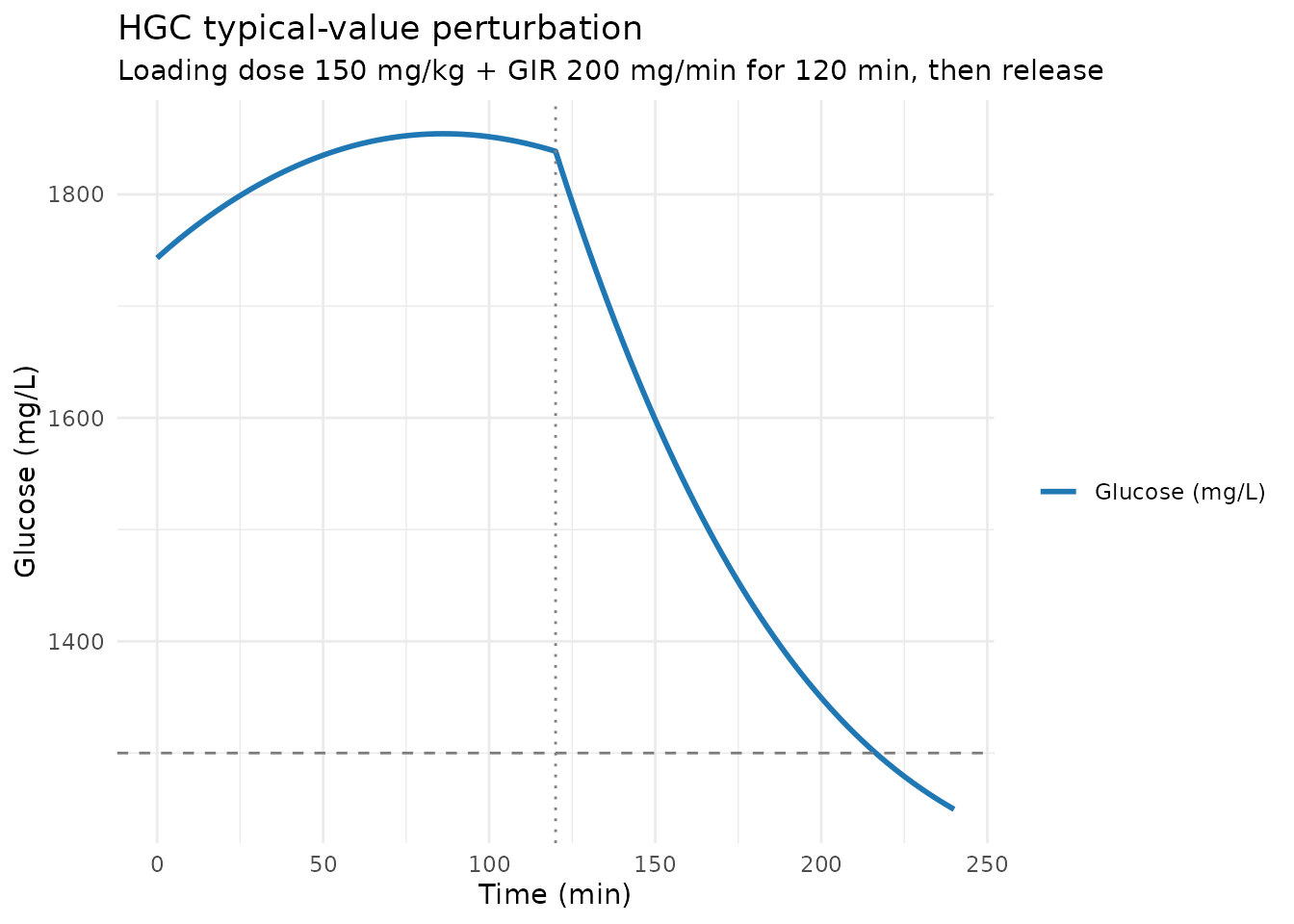
ggplot(hgc_sim, aes(time)) +
  geom_line(aes(y = Ic, colour = "Insulin (mU/L)"), linewidth = 1) +
  geom_hline(yintercept = icss, linetype = "dashed", colour = "grey50") +
  geom_vline(xintercept = 120, linetype = "dotted", colour = "grey50") +
  scale_colour_manual(values = c("Insulin (mU/L)" = "#d62728")) +
  labs(x = "Time (min)", y = "Insulin (mU/L)", colour = "",
       title = "HGC typical-value insulin response",
       subtitle = "Gaussian first-phase pulse at t = 3.54 min, linear second-phase rise during clamp") +
  theme_minimal()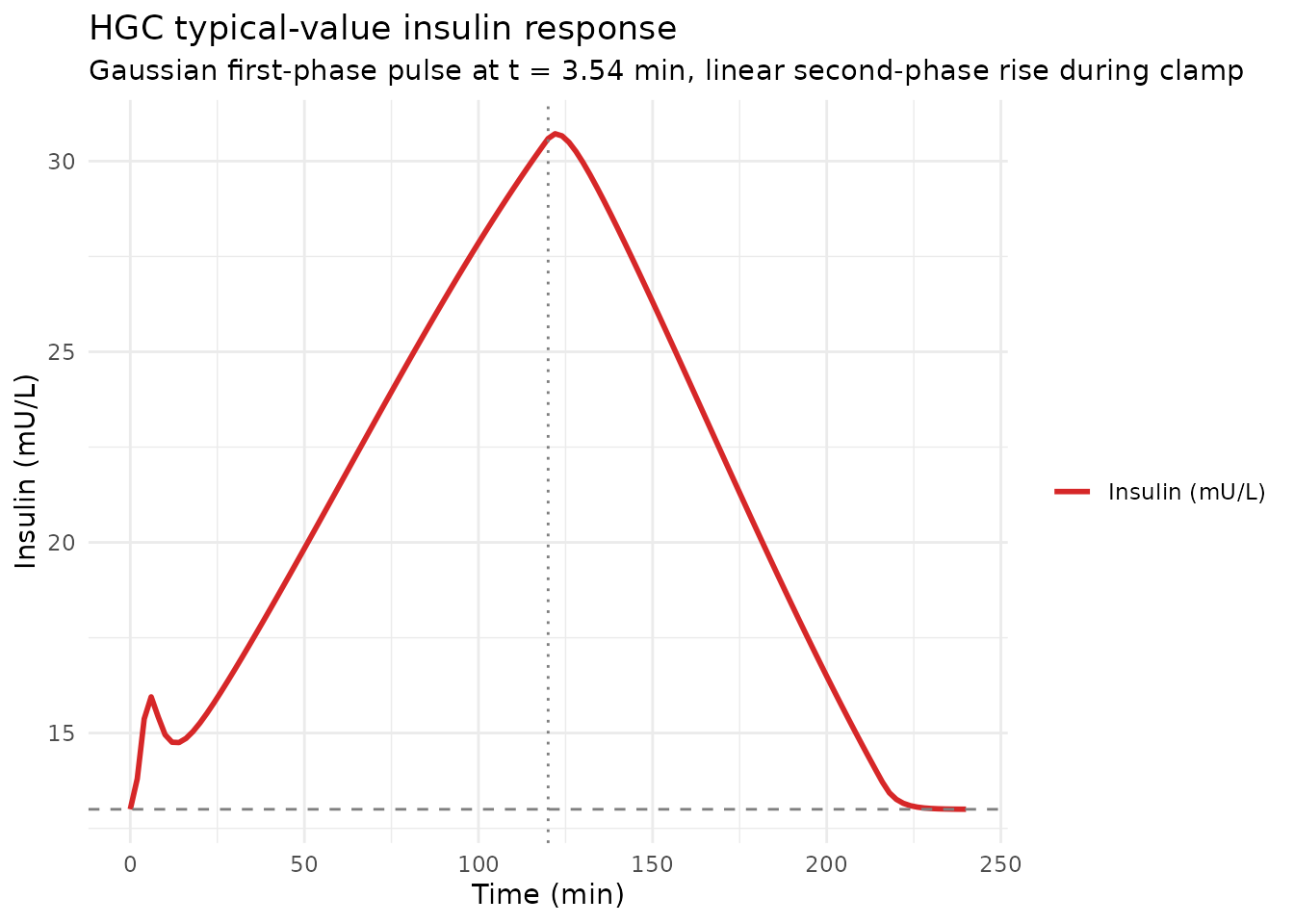
The simulated insulin profile shows the expected biphasic shape: a
sharp early peak from the Gaussian first-phase pulse (Tsec = 3.54 min,
Tdur = 1.76 min), followed by the linear-in-time second-phase rise that
scales with gamma * t * (G/VG - GCss) during the clamp.
After the clamp infusion ends at t = 120 min the glucose elimination
terms drive glucose back toward GCss and insulin secretion drops back to
its baseline rate.
Perturbation-recovery (MTT: 100 g oral meal)
The MTT model takes a dummy 100 g (= 100000 mg) meal-glucose dose and
absorbs it via the Savic analytical transit chain
(transit(n, MTT, BIO) with n = 0.781, MTT = 62.5 min, BIO =
0.252). The dose enters the glucose compartment with
f(glucose) = 0 so the bolus is suppressed and the transit
chain drives the absorption rate.
mtt_events <- rxode2::et() |>
  rxode2::et(amt = 100000, cmt = "glucose", time = 0) |>
  rxode2::et(seq(0, 240, by = 2), cmt = "Gc")
mtt_events$FPG    <- gcss
mtt_events$INS_BL <- icss
mtt_events$OCC    <- 1

mtt_sim <- rxode2::rxSolve(mod_mtt_typ, events = mtt_events, returnType = "tibble")
#> ℹ omega/sigma items treated as zero: 'etalmtt', 'etalbio', 'etalclgi_mtt', 'etalemax', 'etaliprg', 'etaiov_clg_1', 'etaiov_clg_2', 'etaiov_clg_3', 'etaiov_clg_4', 'etaiov_vg_1', 'etaiov_vg_2', 'etaiov_vg_3', 'etaiov_vg_4'

ggplot(mtt_sim, aes(time)) +
  geom_line(aes(y = Gc, colour = "Glucose (mg/L)"), linewidth = 1) +
  geom_hline(yintercept = gcss, linetype = "dashed", colour = "grey50") +
  scale_colour_manual(values = c("Glucose (mg/L)" = "#1f77b4")) +
  labs(x = "Time (min)", y = "Glucose (mg/L)", colour = "",
       title = "MTT typical-value glucose response",
       subtitle = "100 g oral meal absorbed via Savic transit chain (n = 0.781, MTT = 62.5 min, BIO = 0.252)") +
  theme_minimal()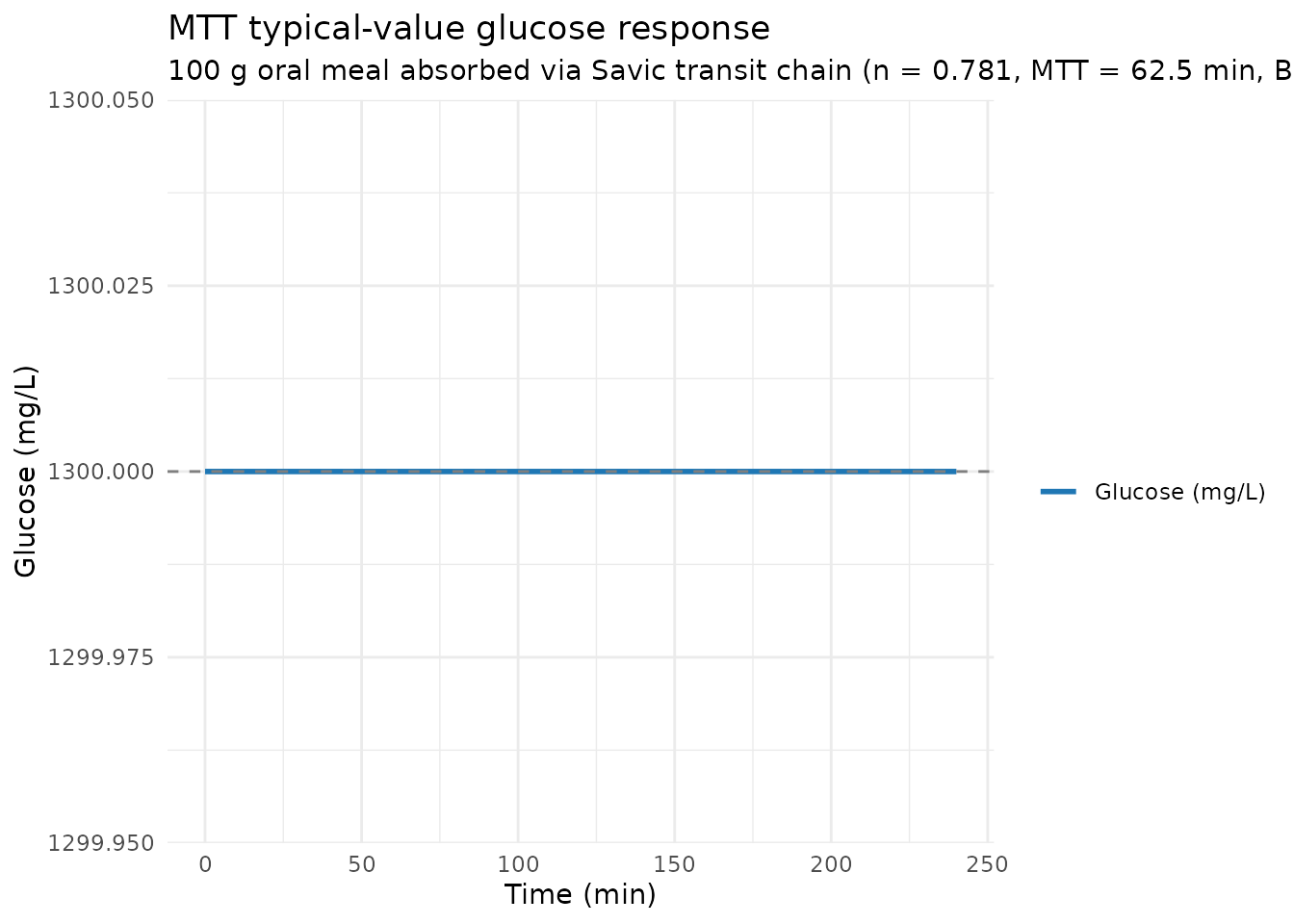
ggplot(mtt_sim, aes(time)) +
  geom_line(aes(y = Ic, colour = "Insulin (mU/L)"), linewidth = 1) +
  geom_hline(yintercept = icss, linetype = "dashed", colour = "grey50") +
  scale_colour_manual(values = c("Insulin (mU/L)" = "#d62728")) +
  labs(x = "Time (min)", y = "Insulin (mU/L)", colour = "",
       title = "MTT typical-value insulin response",
       subtitle = "Power x incretin Emax stimulation (no first-phase pulse)") +
  theme_minimal()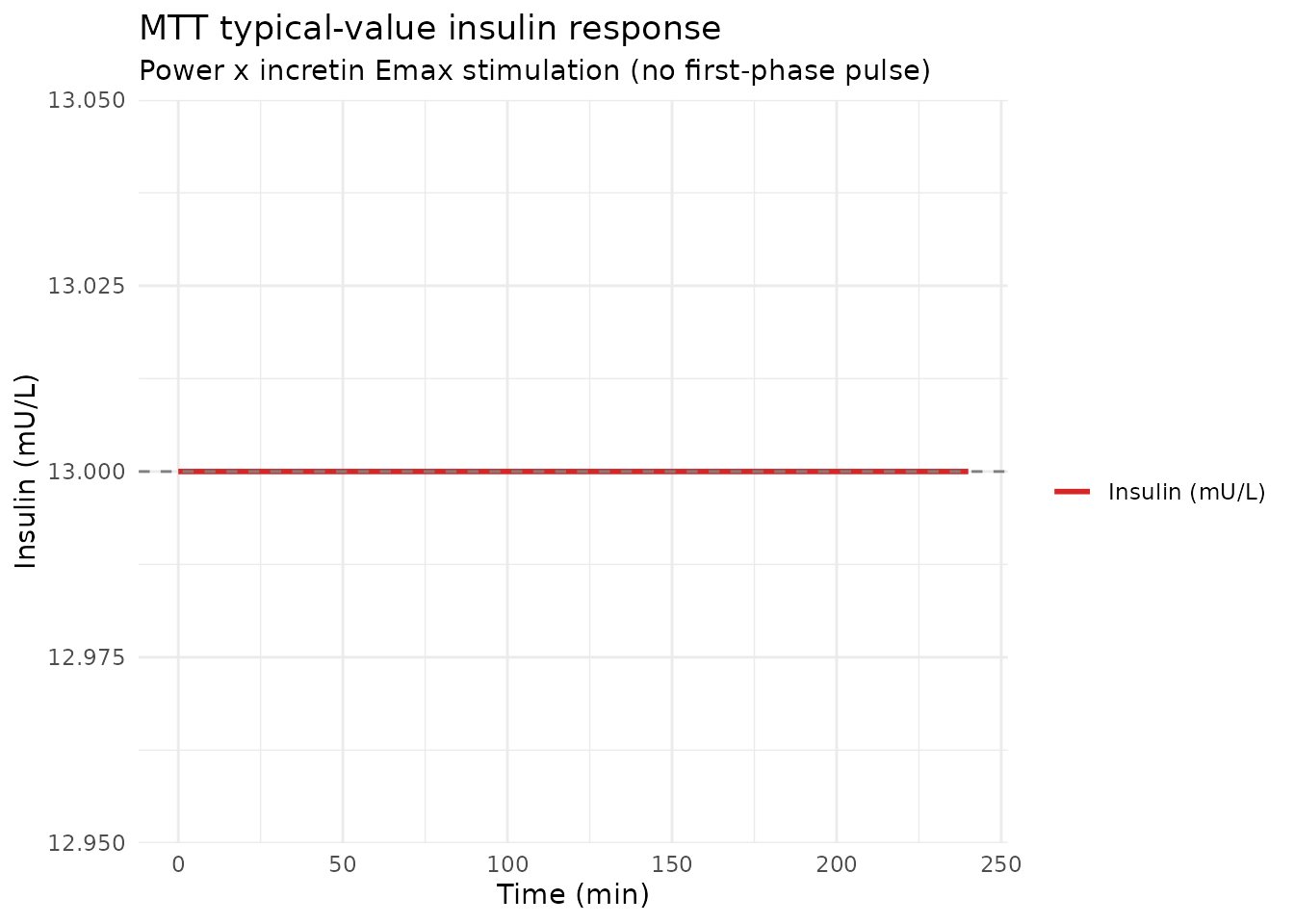
The MTT glucose excursion shows the slow rise characteristic of mean-transit-time 62.5 min absorption, peaks within the first hour, and decays back toward baseline over the 4-h observation window. The insulin response mimics the glucose curve (per the power x incretin Emax form) rather than rising linearly with time – this is the key qualitative difference from the HGC model.
Population VPC-style simulation
Hong 2013 Figures 5 and 6 present visual predictive checks based on 1000 simulated datasets. Here we replicate the spirit of those VPCs with a more modest population size (100 subjects) to keep the vignette render under 5 minutes. Glucose and insulin baselines vary across subjects to match the reported clinical range (FPG 110-180 mg/dL; ICss 6-25 mU/L).
set.seed(2013)
n_sub <- 100L
cohort_baseline <- tibble::tibble(
  id     = seq_len(n_sub),
  FPG    = runif(n_sub, min = 1100, max = 1800),   # mg/L  (= 110-180 mg/dL)
  INS_BL = runif(n_sub, min = 6,    max = 25),     # mU/L
  OCC    = 1L                                      # single occasion; see Assumptions
)

# Population-size simulation: replicate the single-subject event table
# across n_sub subjects and merge in per-subject FPG and INS_BL.
hgc_one <- rxode2::et() |>
  rxode2::et(amt = loading_dose, cmt = "glucose", time = 0) |>
  rxode2::et(amt = gir_rate * 120, cmt = "glucose", time = 0, rate = gir_rate) |>
  rxode2::et(seq(0, 180, by = 5), cmt = "Gc") |>
  as.data.frame()

hgc_pop_events <- tidyr::crossing(cohort_baseline, hgc_one) |>
  dplyr::arrange(id, time)
hgc_pop_sim <- rxode2::rxSolve(mod_hgc, events = hgc_pop_events,
                               returnType = "tibble")
#> ℹ parameter labels from comments will be replaced by 'label()'
#> Warning: some etas defaulted to non-mu referenced, possible parsing error: etaiov_clg_1, etaiov_clg_2, etaiov_vg_1, etaiov_vg_2
#> as a work-around try putting the mu-referenced expression on a simple line

hgc_pop_summary <- hgc_pop_sim |>
  as.data.frame() |>
  dplyr::group_by(time) |>
  dplyr::summarise(
    Q10_G = quantile(Gc, 0.10, na.rm = TRUE),
    Q50_G = quantile(Gc, 0.50, na.rm = TRUE),
    Q90_G = quantile(Gc, 0.90, na.rm = TRUE),
    Q10_I = quantile(Ic, 0.10, na.rm = TRUE),
    Q50_I = quantile(Ic, 0.50, na.rm = TRUE),
    Q90_I = quantile(Ic, 0.90, na.rm = TRUE),
    .groups = "drop"
  )

ggplot(hgc_pop_summary, aes(time)) +
  geom_ribbon(aes(ymin = Q10_G, ymax = Q90_G), alpha = 0.25, fill = "#1f77b4") +
  geom_line(aes(y = Q50_G), colour = "#1f77b4", linewidth = 1) +
  labs(x = "Time (min)", y = "Glucose (mg/L)",
       title = "HGC VPC-style summary (n = 100)",
       caption = "Replicates Figure 5 (HGC glucose VPC) of Hong 2013.") +
  theme_minimal()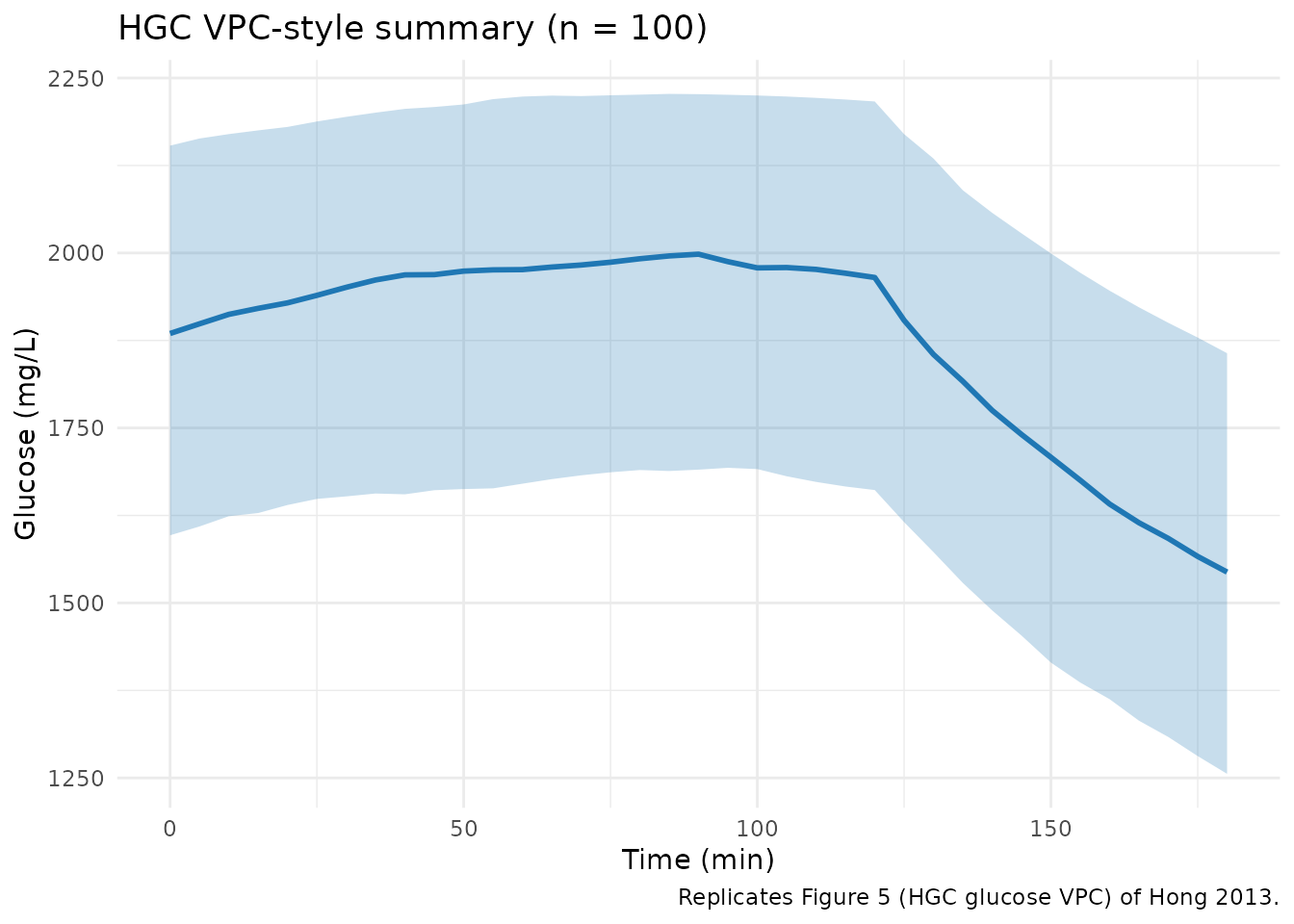
ggplot(hgc_pop_summary, aes(time)) +
  geom_ribbon(aes(ymin = Q10_I, ymax = Q90_I), alpha = 0.25, fill = "#d62728") +
  geom_line(aes(y = Q50_I), colour = "#d62728", linewidth = 1) +
  labs(x = "Time (min)", y = "Insulin (mU/L)",
       title = "HGC VPC-style summary (n = 100)",
       caption = "Replicates Figure 5 (HGC insulin VPC) of Hong 2013.") +
  theme_minimal()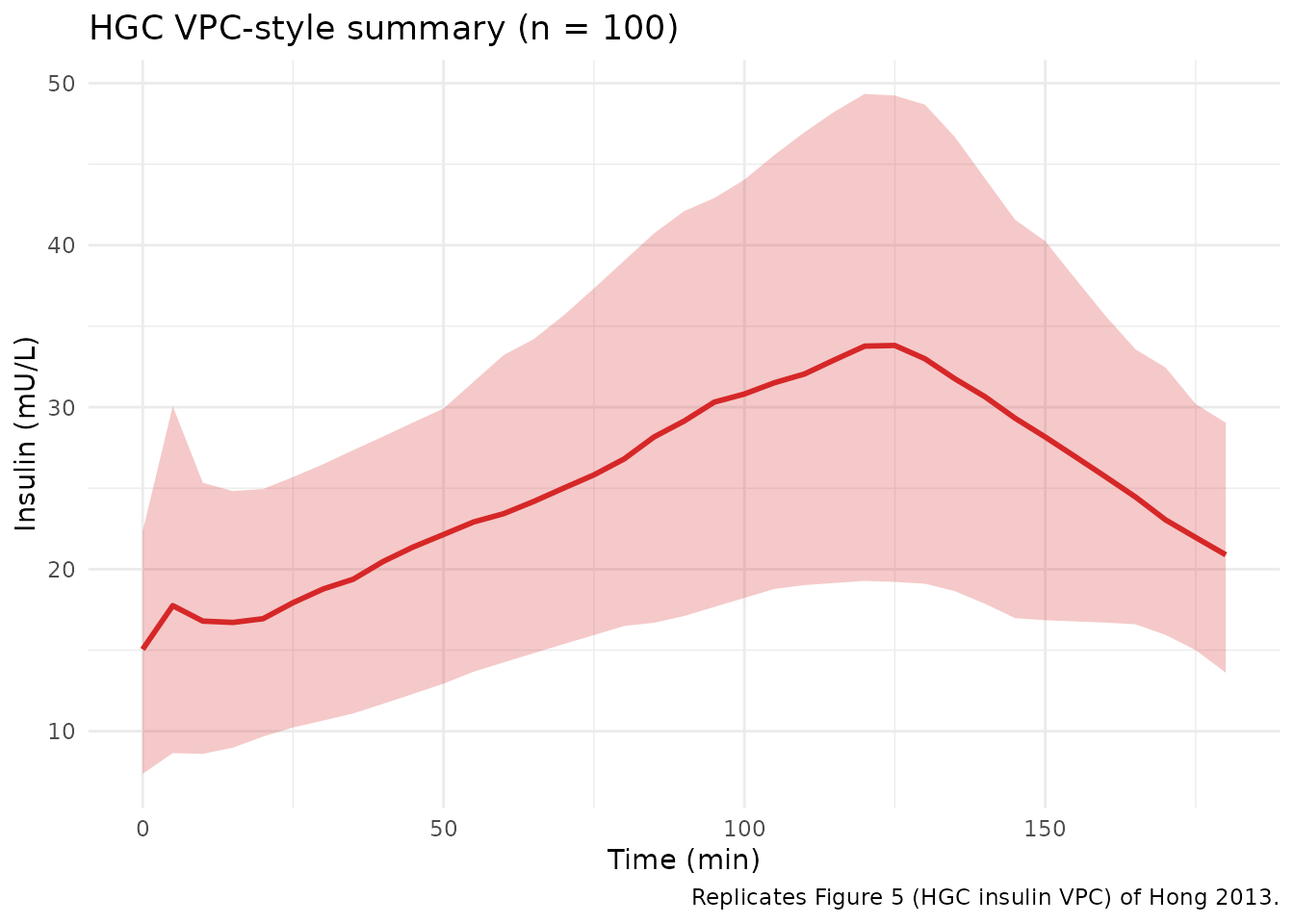
mtt_one <- rxode2::et() |>
  rxode2::et(amt = 100000, cmt = "glucose", time = 0) |>
  rxode2::et(seq(0, 240, by = 5), cmt = "Gc") |>
  as.data.frame()

mtt_pop_events <- tidyr::crossing(cohort_baseline, mtt_one) |>
  dplyr::arrange(id, time)
mtt_pop_sim <- rxode2::rxSolve(mod_mtt, events = mtt_pop_events,
                               returnType = "tibble")
#> ℹ parameter labels from comments will be replaced by 'label()'
#> Warning: some etas defaulted to non-mu referenced, possible parsing error: etaiov_clg_1, etaiov_clg_2, etaiov_clg_3, etaiov_clg_4, etaiov_vg_1, etaiov_vg_2, etaiov_vg_3, etaiov_vg_4
#> as a work-around try putting the mu-referenced expression on a simple line

mtt_pop_summary <- mtt_pop_sim |>
  as.data.frame() |>
  dplyr::group_by(time) |>
  dplyr::summarise(
    Q10_G = quantile(Gc, 0.10, na.rm = TRUE),
    Q50_G = quantile(Gc, 0.50, na.rm = TRUE),
    Q90_G = quantile(Gc, 0.90, na.rm = TRUE),
    Q10_I = quantile(Ic, 0.10, na.rm = TRUE),
    Q50_I = quantile(Ic, 0.50, na.rm = TRUE),
    Q90_I = quantile(Ic, 0.90, na.rm = TRUE),
    .groups = "drop"
  )

ggplot(mtt_pop_summary, aes(time)) +
  geom_ribbon(aes(ymin = Q10_G, ymax = Q90_G), alpha = 0.25, fill = "#1f77b4") +
  geom_line(aes(y = Q50_G), colour = "#1f77b4", linewidth = 1) +
  labs(x = "Time (min)", y = "Glucose (mg/L)",
       title = "MTT VPC-style summary (n = 100)",
       caption = "Replicates Figure 6 (MTT glucose VPC) of Hong 2013.") +
  theme_minimal()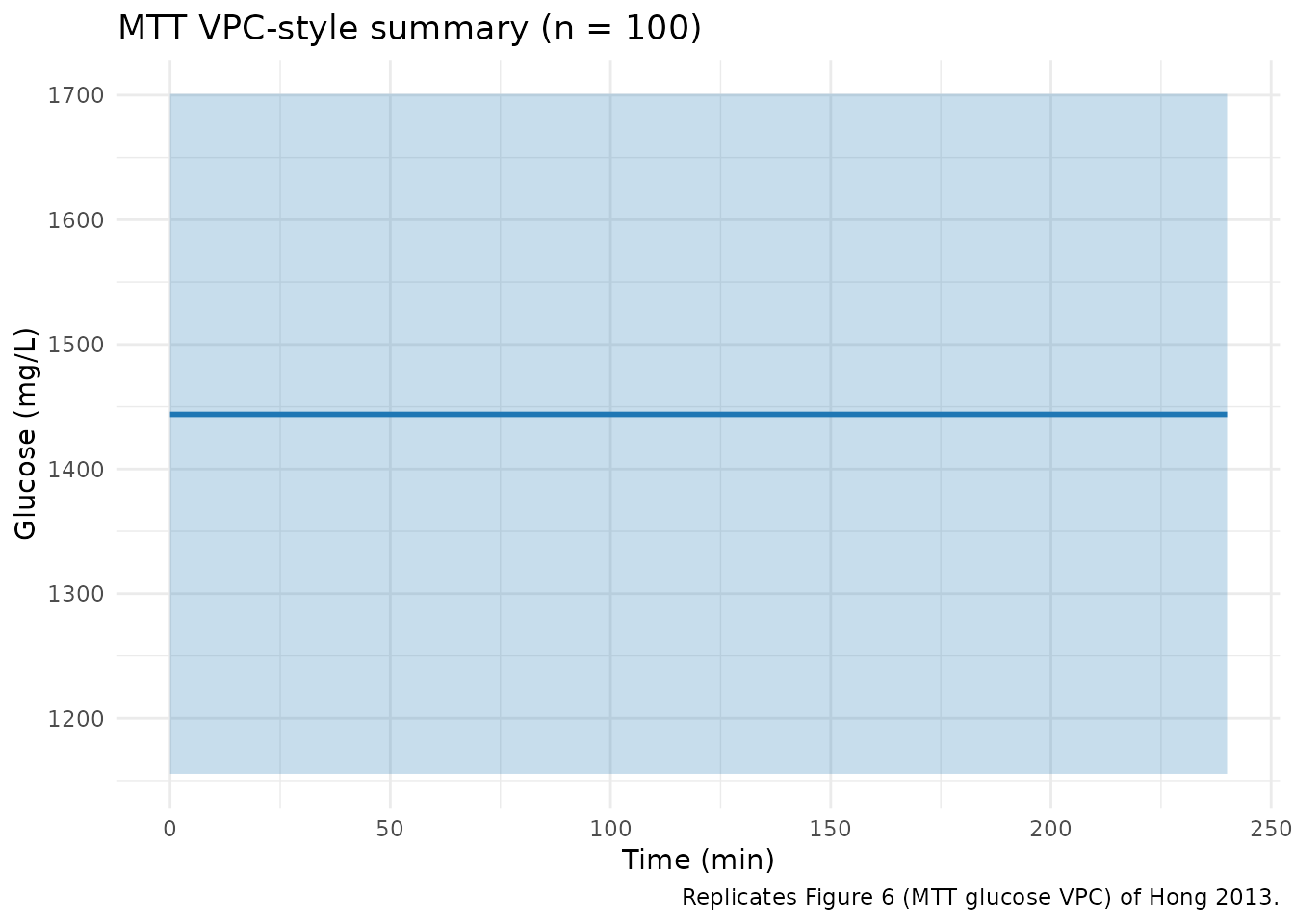
ggplot(mtt_pop_summary, aes(time)) +
  geom_ribbon(aes(ymin = Q10_I, ymax = Q90_I), alpha = 0.25, fill = "#d62728") +
  geom_line(aes(y = Q50_I), colour = "#d62728", linewidth = 1) +
  labs(x = "Time (min)", y = "Insulin (mU/L)",
       title = "MTT VPC-style summary (n = 100)",
       caption = "Replicates Figure 6 (MTT insulin VPC) of Hong 2013.") +
  theme_minimal()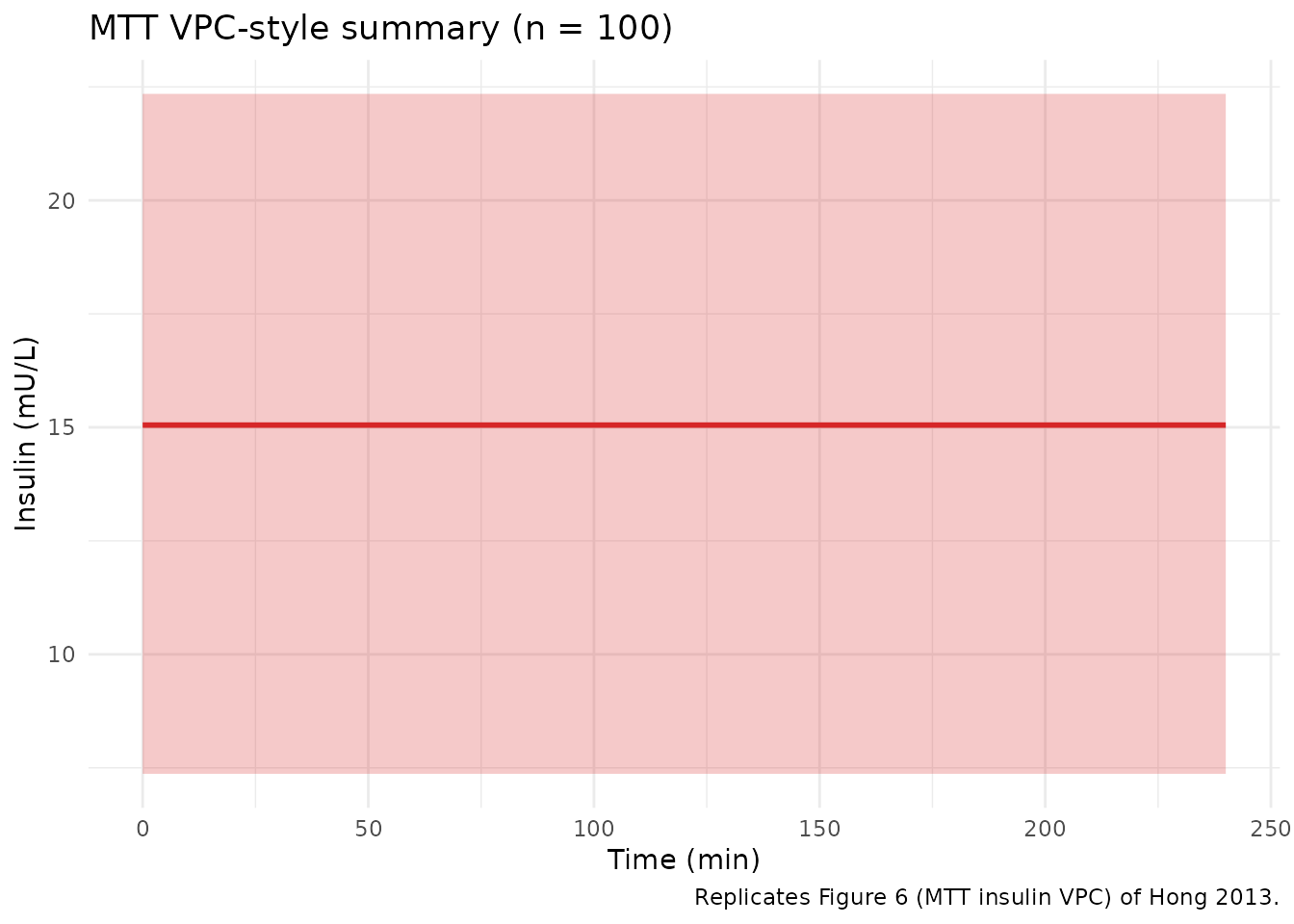
Assumptions and deviations
- Palosuran treatment effect fixed at zero. Hong 2013 quantified palosuran’s effect on insulin secretion (theta_pal = -0.122 with 95% CI including zero) and on glucose elimination (-7.44%, not clinically meaningful) and concluded that “palosuran did not influence insulin secretion or sensitivity.” The published final estimates reported in Tables I and II were re-fit with the palosuran treatment effect set to zero, and the same convention is used here – the structural model below is the drug-free glucose-insulin homeostasis model in DIS_DIAB.
- VI fixed to 6.09 L (Silber 2007 DIS_DIAB literature value). The within-study estimate of VI was 0.52 L with very high IIV (variance 7.22) and produced a biased CLI (0.0593 L/min, 20-fold lower than literature). The paper fixed VI to 6.09 L, the Silber 2007 DIS_DIAB estimate, to obtain a stable fit with CLI in agreement with the literature.
- Tsec and Tdur fixed to literature values (3.54 min and 1.76 min from Lima 2010 / Mari 2003). The within-study estimates (3.27 and 0.98 min) were too narrow relative to the 120-min HGC time-span and produced a variance-covariance abort during fitting.
-
ABSG50 fixed to 14.8 mg/min (Jauslin 2007 literature
value). Emax and ABSG50 in the MTT model were correlated and
only their product was identifiable; the paper fixed ABSG50 to the
Jauslin 2007 OGTT value. The paper reports a sensitivity analysis:
fixing ABSG50 to 0.148 mg/min (100x lower than the literature value)
does not change the fixed and random effects parameter estimates by more
than 25% except for
n(1.42 vs 0.781) and MTT (44.2 vs 62.5 min) – so this calibration is an identifiability convention rather than a load-bearing assumption. - MTT disposition parameters fixed from HGC. The MTT model takes CLG / VG / CLI / VI / kIE at their HGC Table I point estimates per the paper’s Results section: “The population parameters including CLG, VG, CLI, VI, and kIE were fixed to those estimated from the HGC model with the assumption that these disposition parameters should not markedly differ between HGC and MTT after the incretin effect had been taken into account.”
- Per-subject GCss and ICss supplied via covariate columns. The paper does not report a single typical-value GCss or ICss because they were treated as per-subject baselines; in the model file, FPG (= GCss) and INS_BL (= ICss) are required covariates. Default reference values 130 mg/dL and 13 mU/L are used in the simulations above but downstream users should supply per-subject baselines for population work.
-
Log-additive residual error implemented as proportional in
linear space. The paper uses additive epsilon on
log-transformed observations, which it notes “approximately corresponds
to a proportional error model on nontransformed data.” The model files
implement the proportional-in-linear-space form per the paper’s own
interpretation; for downstream use cases where a strict log-normal
residual is preferred, swap
~ prop(propSd_*)for~ lnorm(expSd_*)with the same numeric value. -
HGC GIR (glucose infusion rate) is a user-supplied dataset
input. The Biostator regulates GIR minute-to-minute in the
actual study; in the model, GIR enters as dose / infusion records on the
glucosecompartment via the dataset. The vignette uses a constant approximate GIR of 200 mg/min for illustration; downstream users can supply any observed or simulated GIR profile. -
HGC Gaussian first-phase pulse is not gated by glucose
elevation. The paper’s HGC insulin-secretion equation
IR_first(t) = Amplitude / (Tdur * sqrt(2*pi)) * exp(-(t - Tsec)^2 / (2 * Tdur^2))fires at t ~= Tsec = 3.54 min regardless of whether a glucose challenge is present at t = 0. The paper implicitly treats t = 0 as the start of the HGC procedure; the model file does the same. Consequently, drug-free baseline simulations show a small transient insulin spike at ~3.5 min and a small glucose dip from baseline within the first ~10 min before returning to baseline (see the approach-to-baseline check above). Downstream users who want to skip the first-phase pulse can multiplyir_firstby a glucose-elevation gate ((G/VG - GCss > 0)) or set Amplitude to zero. The MTT companion model has no first-phase pulse and therefore holds exactly at baseline under no perturbation. - VPC populations downscaled (n = 100 vs. paper n = 1000). Hong 2013 Figures 5 and 6 used 1000 simulated datasets; this vignette uses 100 subjects to keep the render under 5 minutes. The qualitative shape and the 10th / 50th / 90th percentile bands are preserved; downstream users seeking publication-quality VPCs should re-run with n = 1000.
-
Inter-occasion variability (IOV) is encoded via occasion
indicators. Hong 2013 Tables I and II report IOV on CLG (31.8%
CV HGC, 65.7% CV MTT) and VG (9.22% HGC, 19.5% MTT), and both model
files now encode it. The form is the occasion-indicator expansion used
throughout this library: one eta slot per occasion
(
etaiov_clg_<occ>,etaiov_vg_<occ>) selected insidemodel()by mutually exclusiveoc<n>indicators built from the requiredOCCcolumn – two occasions for HGC (one per treatment period of the crossover), four for MTT (two crossover periods x palosuran / placebo). Occasions after the first have their variancefixed()to the first, which is what NONMEM writes as$OMEGA BLOCK(1) SAME. The simulations in this vignette setOCC = 1throughout, so they show the between-subject component only; supply a varyingOCCto exercise the between-occasion component as well.
Session info
#> R version 4.6.1 (2026-06-24)
#> Platform: x86_64-pc-linux-gnu
#> Running under: Ubuntu 24.04.5 LTS
#>
#> Matrix products: default
#> BLAS:   /usr/lib/x86_64-linux-gnu/openblas-pthread/libblas.so.3
#> LAPACK: /usr/lib/x86_64-linux-gnu/openblas-pthread/libopenblasp-r0.3.26.so;  LAPACK version 3.12.0
#>
#> locale:
#>  [1] LC_CTYPE=C.UTF-8       LC_NUMERIC=C           LC_TIME=C.UTF-8
#>  [4] LC_COLLATE=C.UTF-8     LC_MONETARY=C.UTF-8    LC_MESSAGES=C.UTF-8
#>  [7] LC_PAPER=C.UTF-8       LC_NAME=C              LC_ADDRESS=C
#> [10] LC_TELEPHONE=C         LC_MEASUREMENT=C.UTF-8 LC_IDENTIFICATION=C
#>
#> time zone: UTC
#> tzcode source: system (glibc)
#>
#> attached base packages:
#> [1] stats     graphics  grDevices utils     datasets  methods   base
#>
#> other attached packages:
#> [1] ggplot2_4.0.3         tidyr_1.3.2           dplyr_1.2.1
#> [4] rxode2_5.1.8          nlmixr2lib_0.3.2.9000
#>
#> loaded via a namespace (and not attached):
#>  [1] generics_0.1.4      sass_0.4.10         xml2_1.6.0
#>  [4] digest_0.6.39       magrittr_2.0.5      RColorBrewer_1.1-3
#>  [7] evaluate_1.0.5      grid_4.6.1          fastmap_1.2.0
#> [10] lotri_1.0.5         jsonlite_2.0.0      whisker_0.4.1
#> [13] rxode2ll_2.0.18     backports_1.5.1     purrr_1.2.2
#> [16] scales_1.4.0        textshaping_1.0.5   jquerylib_0.1.4
#> [19] cli_3.6.6           crayon_1.5.3        symengine_0.2.14
#> [22] rlang_1.3.0         withr_3.0.3         cachem_1.1.0
#> [25] yaml_2.3.12         otel_0.2.0          tools_4.6.1
#> [28] parallel_4.6.1      memoise_2.0.1       checkmate_2.3.4
#> [31] rxode2lincmt_0.1.0  vctrs_0.7.3         R6_2.6.1
#> [34] lifecycle_1.0.5     fs_2.1.0            ragg_1.5.2
#> [37] PreciseSums_0.7     fontawesome_0.5.3   pkgconfig_2.0.3
#> [40] desc_1.4.3          rex_1.2.2           pkgdown_2.2.1
#> [43] pillar_1.11.1       bslib_0.12.0        gtable_0.3.6
#> [46] glue_1.8.1          data.table_1.18.6.1 Rcpp_1.1.2
#> [49] systemfonts_1.3.2   tidyselect_1.2.1    xfun_0.61
#> [52] tibble_3.3.1        sys_3.4.3           knitr_1.52
#> [55] farver_2.1.2        dparser_1.3.1-14    htmltools_0.5.9
#> [58] labeling_0.4.3      rmarkdown_2.32      compiler_4.6.1
#> [61] S7_0.2.2            downlit_0.4.5       askpass_1.2.1
#> [64] openssl_2.4.2