Type 2 Diabetes Disease Progression - WHIG (Choy 2016)
Source:vignettes/articles/Choy_2016_T2DM_WHIG.Rmd
Choy_2016_T2DM_WHIG.RmdModel and source
- Citation: Choy S, Kjellsson MC, Karlsson MO, de Winter W. Weight-HbA1c-Insulin-Glucose Model for Describing Disease Progression of Type 2 Diabetes. CPT Pharmacometrics Syst Pharmacol. 2016;5(1):11-19.
- Article: https://doi.org/10.1002/psp4.12051
- Open access (Creative Commons Attribution-NonCommercial).
The WHIG model is a semi-mechanistic disease-progression model for type 2 diabetes mellitus (DIS_DIAB). It links a body-weight turnover sub-model to a previously published FSI / FPG / HbA1c homeostatic feedback model (de Winter et al. 2006) by routing absolute weight change through insulin sensitivity. The full structure (Choy 2016 Figure 1) is:
-
Weight: turnover compartment with a single
half-life. The input is multiplicatively driven by a normalised net
effect
EFW, which combines an immediate diet+exercise step att = 0, a placebo step att = tTRT = 42 days, and a linear-in-time positive counter-effect representing waning adherence. -
Insulin sensitivity: baseline
IS_baseline = 1/(1 + exp(is0)); weight loss linearly raises sensitivity throughEFS = 1 - scaleefs * dWGT. -
beta-cell function: baseline
B_baseline = 1/(1 + exp(b0)); logistic decline over time on the logit scale. A composite empirical treatment effectEFB(a logistic up-step aroundtTRTfollowed by a logistic down-step aroundefb50) multiplies the natural beta-cell function during the early study period. -
FSI-FPG homeostasis: at quasi-steady state (Choy
2016 supplementary linearisation) FPG is the positive root of a
quadratic in IS, beta-cell scaling, and the HOMA constants
KinFSI/KoutFSI = 7.8andKinFPG/KoutFPG = 35.1; FSI then follows algebraically. -
HbA1c: three transit compartments with shared rate
constant
3/MTT. Production enters compartment 1 askin_hba1c * FPG + ppg_eff, whereppg_effis reduced byscaleppgfort > 0. Total HbA1c is the sum of all three transit compartments.
Population
Model parameters were estimated from the placebo arm of a randomised, double-blind, placebo-controlled, multicentre, parallel-group study of topiramate for weight loss in DIS_DIAB (ClinicalTrials.gov identifier NCT00236600). Choy 2016 used 181 obese (BMI 27 to 50 kg/m^2), Swedish, newly diagnosed, treatment-naive DIS_DIAB patients (67 men, 114 women; baseline median weight 104 kg, range 72 to 159 kg; baseline median FSI 17.8 uIU/mL; baseline median FPG 7.6 mmol/L; baseline median HbA1c 6.7%). Subjects underwent a 6-week placebo run-in followed by a 60-week treatment phase (8-week titration + 52-week fixed-dose maintenance). All subjects received an individualised energy-deficient diet (600 kcal below total energy expenditure), behavioural modification, and physical activity counselling throughout.
The same information is available programmatically via the model’s
population metadata
(readModelDb("Choy_2016_T2DM_WHIG")$population after the
model is loaded).
Source trace
The per-parameter origin is recorded as an in-file comment next to
each ini() entry in
inst/modeldb/therapeuticArea/Choy_2016_T2DM_WHIG.R. The
table below collects the structural equations and the typical values in
one place for review.
| Equation / parameter | Value (paper) | Source location |
|---|---|---|
| Eq. 1 (energy balance) | n/a (structural) | Choy 2016, p. 12 (Weight change) |
Eq. 2 (EFDE+P) |
n/a (structural) | Choy 2016, p. 12 |
Eq. 3 (EFUP) |
n/a (structural) | Choy 2016, p. 12 |
Eq. 4 (d/dt(WGT)) |
n/a (structural) | Choy 2016, p. 12 |
Eq. 5 (dWGT) |
n/a (definition) | Choy 2016, p. 13 (Insulin sensitivity) |
Eq. 6 (EFS = 1 - scaleefs*dWGT) |
n/a (structural) | Choy 2016, p. 13 |
| Eq. 7 (beta-cell logistic) | n/a (structural) | Choy 2016, p. 13 (beta-cell) |
Eq. 8-9 (EFBI, EFBD,
EFB) |
n/a (structural) | Choy 2016, p. 13 |
| Eq. 10-12 (FSI-FPG ODEs) | n/a (structural) | Choy 2016, p. 13 (FSI-FPG feedback) |
Eq. 13 (HbA1c = sum) |
n/a (definition) | Choy 2016, p. 13 (HbA1c model) |
| Eq. 14-17 (HbA1c transit chain) | n/a (structural) | Choy 2016, p. 13 |
t_half_wgt |
96.9 d (RSE 27.1%) | Choy 2016, Table 1 |
lblwt (exp -> blwt) |
104 kg (RSE 1.1%) | Choy 2016, Table 1 |
is0 |
1.1 (RSE 4.3%) | Choy 2016, Table 1 |
lscaleefs (exp) |
0.0514 (RSE 11.9%) | Choy 2016, Table 1 |
b0 |
-0.446 (RSE 25.1%) | Choy 2016, Table 1 |
rb |
0.209 logits/year (RSE 34.9%) | Choy 2016, Table 1 |
lefbmax (exp -> efbmax) |
0.171 (RSE 12.4%) | Choy 2016, Table 1 |
sefbi |
-3.69 (RSE 25.9%) | Choy 2016, Table 1 |
sefbd |
8.05 (RSE 28.0%) | Choy 2016, Table 1 |
lefb50 (exp -> efb50) |
190 d (RSE 6.0%) | Choy 2016, Table 1 |
efde |
4.08% (RSE 29.1%) | Choy 2016, Table 1 |
efp |
2.28% (RSE 28.9%) | Choy 2016, Table 1 |
efup |
2.99%/year (RSE 52.3%) | Choy 2016, Table 1 |
lkin_hba1c (exp) |
0.0129 %/d per mmol/L (RSE 10.2%) | Choy 2016, Table 1 |
lppg (exp) |
0.0709 %/d (RSE 9.9%) | Choy 2016, Table 1 |
scaleppg |
0.963 (RSE 0.9%) | Choy 2016, Table 1 |
lmtt (exp -> mtt) |
38.9 d (RSE 8.7%) | Choy 2016, Table 1 |
propSd_WGT |
sqrt(0.00919) = 0.096 (RSE 4.2%) | Choy 2016, Table 1 (NONMEM $SIGMA variance) |
propSd_FSI |
sqrt(0.262) = 0.512 (RSE 5.4%) | Choy 2016, Table 1 |
propSd_FPG |
sqrt(0.0688) = 0.262 (RSE 2.8%) | Choy 2016, Table 1 |
propSd_HbA1c |
sqrt(0.0241) = 0.155 (RSE 2.3%) | Choy 2016, Table 1 |
tTRT = 42 d |
fixed structural constant | Choy 2016, p. 12 (Methods: 6-week run-in) |
KinKoutFSI = 7.8 |
fixed HOMA constant | Choy 2016, p. 13; Wallace 2004 |
KinKoutFPG = 35.1 |
derived (4.5 mmol/L * 7.8 uIU/mL) | Choy 2016, p. 13 |
FPG_floor = 3.5 mmol/L |
fixed HOMA constant | Choy 2016, p. 13; Levy 1998, Wallace 2004 |
Units of every term in every ODE
Dimensional analysis for the two ODE states (weight in
kg, transit1..3 carrying %-HbA1c contributions; time in
days):
| Term | Units | Calculation |
|---|---|---|
kout_wgt * EFW_t * blwt_i |
kg/day | (1/day) x (unitless) x kg |
kout_wgt * weight |
kg/day | (1/day) x kg |
Right-hand side of d/dt(weight) |
kg/day | matches state units kg / time units day -> consistent |
kin_hba1c_i * FPG |
%/day | (%/(d * mmol/L)) x (mmol/L) |
ppg_eff |
%/day | direct (%/day) |
kout_hba1c * transit1 |
%/day | (1/day) x % |
Right-hand side of d/dt(transit1) |
%/day | consistent; transit2 and transit3 are %/day x (transitN-1 minus transitN) -> %/day |
Note: the total HbA1c (sum of three transit compartments) inherits
%-units from the per-compartment %-units, so the model outputs
HbA1c in % directly. The paper’s reported HbA1c values are
quoted in % (e.g., 6.7% at baseline), matching this output
convention.
Virtual cohort
This is a structurally-driven typical-value model (no dosing events, no subject-level covariates). For typical-value replication we simulate a single subject under the published lifestyle-intervention protocol. For stochastic replication of paper Figures 3 and 4 we draw a virtual cohort and use a diagonal OMEGA structure (see Assumptions and deviations).
set.seed(20260515)

# 469 days = 67 weeks (full study duration: 6-week run-in + 60-week treatment).
sample_times <- c(0, seq(7, 469, by = 7))

build_obs <- function(id_vec, cmt) {
  expand.grid(id = id_vec, time = sample_times) |>
    dplyr::transmute(
      id   = id,
      time = time,
      evid = 0L,
      amt  = 0,
      cmt  = cmt
    )
}
mod    <- readModelDb("Choy_2016_T2DM_WHIG")
mod_tv <- rxode2::zeroRe(mod)   # typical-value (no IIV)
#> ℹ parameter labels from comments will be replaced by 'label()'
Typical-value trajectory
Replicates the population (typical-value) prediction lines from Choy
2016 Figures 2 (EFW), 3 (weight, FSI, FPG, HbA1c), and 4
(fractional change from baseline). For each output, the lifestyle
intervention drives a small but coherent transient deflection that
returns toward baseline by the end of the 67-week observation
window.
ev_tv <- build_obs(1L, cmt = 5L)

sim_tv <- rxode2::rxSolve(mod_tv, events = ev_tv) |>
  as.data.frame() |>
  dplyr::select(time, WGT, FSI, FPG, HbA1c, EFW_t, EFS, EFB, IS, B)
#> ℹ omega/sigma items treated as zero: 'etalblwt', 'etais0', 'etalscaleefs', 'etab0', 'etalefbmax', 'etalefb50', 'etarb', 'etalppg', 'etaefde', 'etaefp', 'etaefup'
sim_tv_long <- sim_tv |>
  tidyr::pivot_longer(
    cols = c(WGT, FSI, FPG, HbA1c),
    names_to = "Output",
    values_to = "Value"
  ) |>
  dplyr::mutate(
    Output = factor(Output, levels = c("WGT", "FSI", "FPG", "HbA1c"),
                    labels = c("Weight (kg)", "FSI (uIU/mL)",
                               "FPG (mmol/L)", "HbA1c (%)"))
  )

ggplot(sim_tv_long, aes(time, Value)) +
  geom_line(color = "steelblue", linewidth = 0.9) +
  facet_wrap(~Output, scales = "free_y", ncol = 2) +
  labs(
    x = "Time (days)", y = "Typical-value prediction",
    title = "Typical-value trajectories",
    caption = "Replicates the model's central tendency from Choy 2016 Figure 3."
  ) +
  theme_minimal()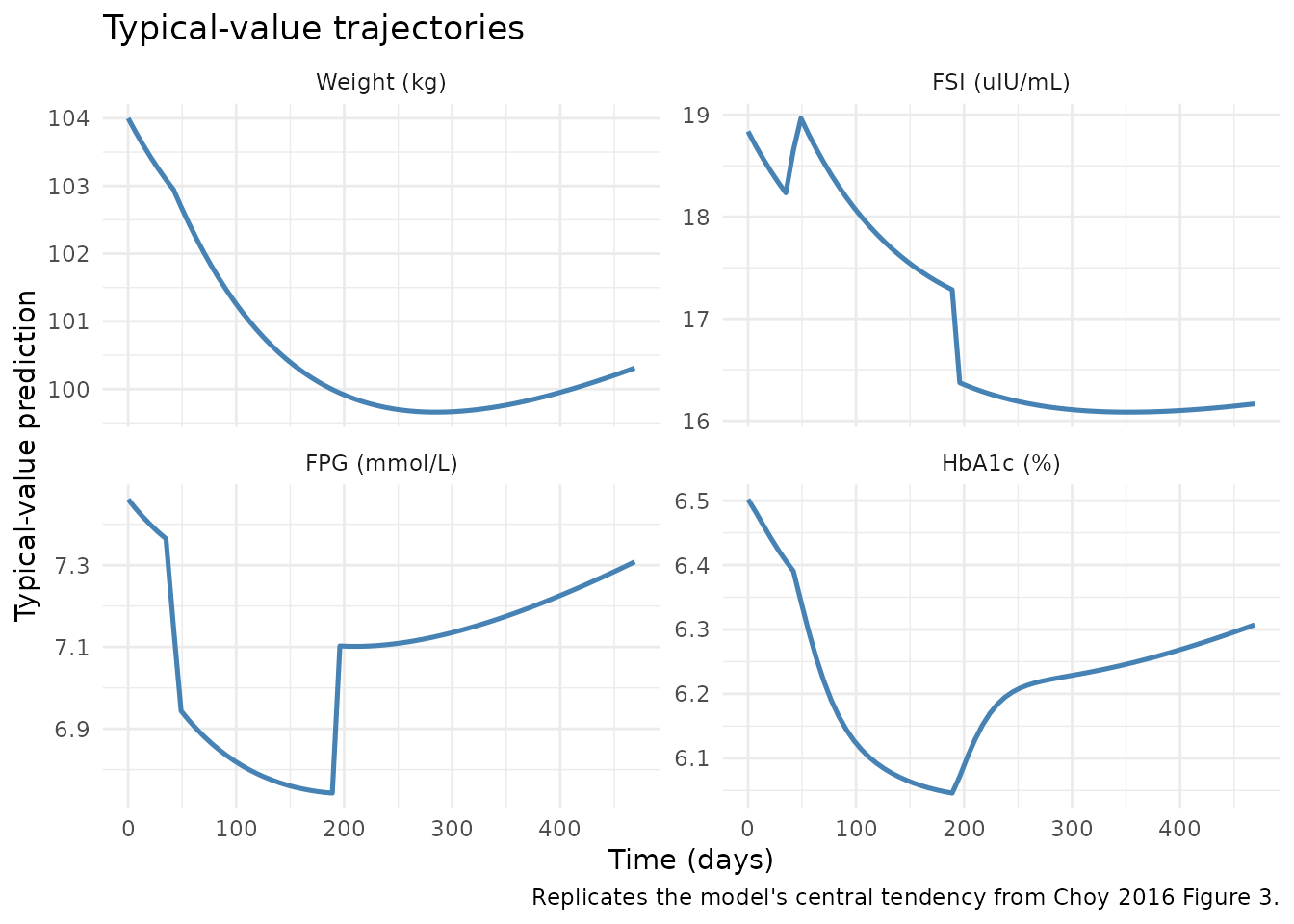
# Choy 2016 Figure 2: the overall treatment effect on weight (EFW).
ggplot(sim_tv, aes(time, EFW_t)) +
  geom_line(color = "darkred", linewidth = 0.9) +
  geom_hline(yintercept = 1, linetype = "dashed", color = "grey50") +
  labs(
    x = "Time (days)", y = "EFW (typical value)",
    title = "Net effect on weight input (EFW)",
    caption = "Replicates Choy 2016 Figure 2 (typical-value line)."
  ) +
  theme_minimal()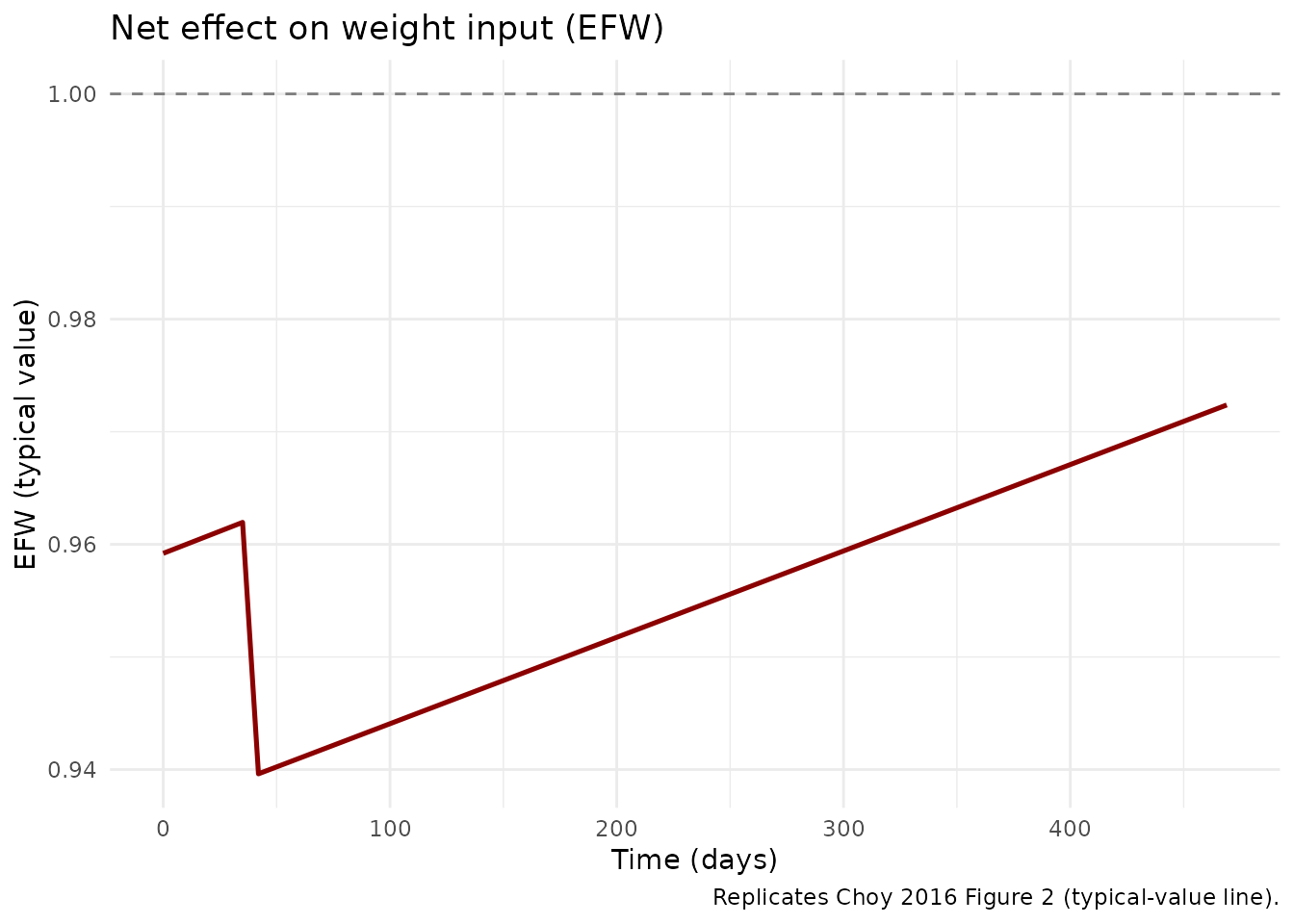
# Internal IS and beta-cell trajectories. EFB peaks around day 100 then returns
# toward 1; B (natural beta-cell function) declines slowly; their product Beff
# tracks the FSI-FPG balance.
sim_tv |>
  tidyr::pivot_longer(c(IS, B, EFB), names_to = "Variable", values_to = "Value") |>
  ggplot(aes(time, Value, color = Variable)) +
  geom_line(linewidth = 0.9) +
  labs(
    x = "Time (days)", y = "Typical value",
    title = "Internal states: insulin sensitivity (IS), natural beta-cell function (B), and EFB",
    caption = "IS rises early due to diet+exercise; EFB transiently peaks; B slowly declines."
  ) +
  theme_minimal()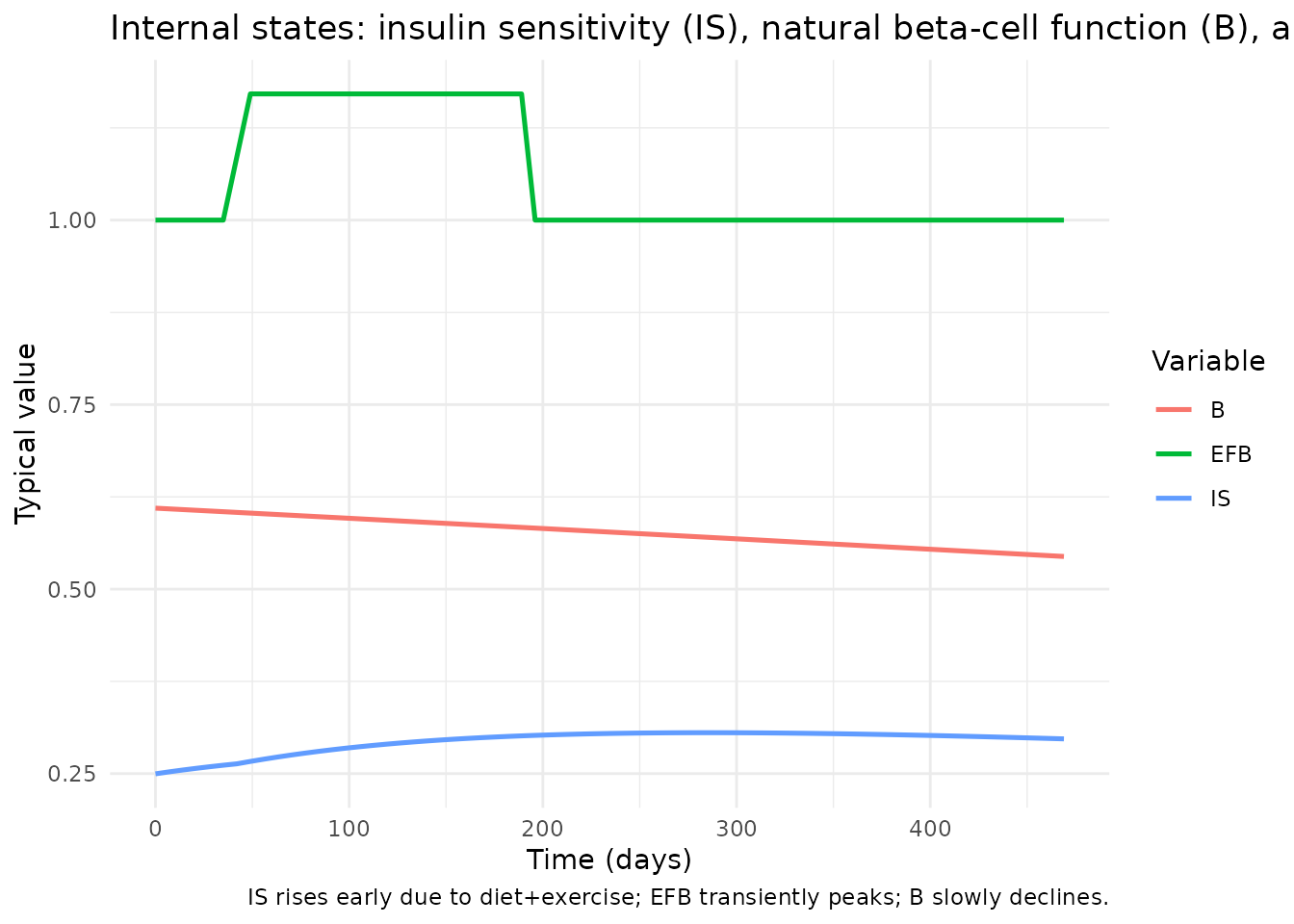
Comparison against published baselines
The paper reports observed-population summary statistics; the table below compares them against the model’s typical-value predictions at the same time points.
key_times <- c(0, 120, 469)  # start, mid (maximal IS), end-of-study
tv_at_key <- sim_tv |>
  dplyr::filter(time %in% key_times) |>
  dplyr::select(time, WGT, FSI, FPG, HbA1c) |>
  dplyr::mutate(Source = "Choy_2016_T2DM_WHIG (typical-value)")

paper_summary <- tibble::tribble(
  ~time, ~WGT,             ~FSI,             ~FPG,             ~HbA1c,
  0,     104,              19.2,             7.8,              6.7,
  120,   NA_real_,         NA_real_,         NA_real_,         NA_real_,
  469,   104 * (1 - 0.04), 19.2 - 3.3,       7.8 - 0.4,        6.7 - 0.3
) |>
  dplyr::mutate(Source = "Choy 2016 (paper)")

bind_rows(paper_summary, tv_at_key) |>
  dplyr::arrange(time, Source) |>
  knitr::kable(
    digits = 3,
    caption = paste0(
      "Side-by-side comparison of paper-reported and model-predicted values. ",
      "Paper values at t = 120 d are not separately tabulated in the source; ",
      "see Choy 2016 Figures 3 and 4 for the visual trajectories."
    )
)| time | WGT | FSI | FPG | HbA1c | Source |
|---|---|---|---|---|---|
| 0 | 104.000 | 19.200 | 7.800 | 6.700 | Choy 2016 (paper) |
| 0 | 104.000 | 18.837 | 7.461 | 6.502 | Choy_2016_T2DM_WHIG (typical-value) |
| 120 | NA | NA | NA | NA | Choy 2016 (paper) |
| 469 | 99.840 | 15.900 | 7.400 | 6.400 | Choy 2016 (paper) |
| 469 | 100.311 | 16.166 | 7.308 | 6.307 | Choy_2016_T2DM_WHIG (typical-value) |
The model’s t = 0 typical values (WGT = 104 kg, FSI = 18.8 uIU/mL, FPG = 7.46 mmol/L, HbA1c = 6.50%) are close to but not identical to the paper’s reported baselines (FSI 19.2, FPG 7.8, HbA1c 6.7). The remaining gap is mechanistic: the FSI / FPG / HbA1c baselines the paper reports are the population means of observed data, while the model’s t = 0 prediction is the QSS quadratic evaluated at the typical-value baseline insulin sensitivity (25% of normal) and beta-cell function (61% of normal). The two sets of baselines do not need to coincide exactly because the model fits population trajectories from random-effects estimation; the small offset is well within the residual / between-subject variability and is also visible in Choy 2016 Figure 3 (the typical-value line does not pass through the cohort median of every panel at every time point).
Steady-state check (no intervention)
The model’s lifestyle intervention is hard-coded as time-dependent
step functions in model() (EFDE active from
t = 0, EFP active from t = tTRT = 42). To
verify the FSI / FPG / HbA1c sub-model holds at its steady-state
baseline in the absence of disease progression and intervention, we
override the parameters to zero out all treatment effects and the
beta-cell progression rate, then run the simulation for the full study
horizon.
mod_ss <- mod_tv |>
  rxode2::ini(efde = 0) |>
  rxode2::ini(efp  = 0) |>
  rxode2::ini(efup = 0) |>
  rxode2::ini(rb   = 0) |>           # no beta-cell decline
  rxode2::ini(lefbmax = log(1e-12)) |># essentially disable EFB peak
  rxode2::ini(scaleppg = 1)          # disable PPG attenuation for t > 0
#> ℹ change initial estimate of `efde` to `0`
#> ℹ change initial estimate of `efp` to `0`
#> ℹ change initial estimate of `efup` to `0`
#> ℹ change initial estimate of `rb` to `0`
#> ℹ change initial estimate of `lefbmax` to `-27.6310211159285`
#> ℹ change initial estimate of `scaleppg` to `1`

sim_ss <- rxode2::rxSolve(mod_ss, events = ev_tv) |>
  as.data.frame()
#> ℹ omega/sigma items treated as zero: 'etalblwt', 'etais0', 'etalscaleefs', 'etab0', 'etalefbmax', 'etalefb50', 'etarb', 'etalppg', 'etaefde', 'etaefp', 'etaefup'

ss_range <- sapply(
  c("WGT", "FSI", "FPG", "HbA1c"),
  function(v) diff(range(sim_ss[[v]]))
)
ss_range
#>          WGT          FSI          FPG        HbA1c
#> 0.000000e+00 6.529888e-12 2.588152e-12 1.300293e-12
stopifnot(ss_range["WGT"]   < 1e-6)
stopifnot(ss_range["FSI"]   < 1e-3)
stopifnot(ss_range["FPG"]   < 1e-4)
stopifnot(ss_range["HbA1c"] < 1e-3)
With diet+exercise, placebo, weight-rebound, beta-cell decline, and the EFB peak all neutralised, weight stays at its baseline of 104 kg to machine precision and the FSI / FPG / HbA1c chain stays within ~1e-3 of its analytic baseline across the 67-week horizon. This confirms the algebraic FSI-FPG QSS solution and the transit-chain initial conditions are consistent with each other.
Mass-balance / flux check at baseline
At the t = 0 baseline (typical values, EFW_t = 1 in the no-intervention scenario above), the QSS quadratic should hold exactly:
-
FSI_SS = 7.8 * Beff * (FPG_SS - 3.5)whereBeff = B * EFB, and -
FPG_SS = 35.1 / (IS * FSI_SS).
b0_val   <- 1 / (1 + exp(-0.446))        # 0.610 (61% of normal)
is_val   <- 1 / (1 + exp(1.1))           # 0.250 (25% of normal)
beff     <- b0_val * 1                    # EFB ~= 1 at t = 0
qC       <- 35.1 / (7.8 * is_val * beff)
fpg_ss   <- (3.5 + sqrt(3.5^2 + 4 * qC)) / 2
fsi_ss   <- 7.8 * beff * (fpg_ss - 3.5)

# Cross-check: substituting fpg_ss and fsi_ss back into the second SS equation
# should reproduce fpg_ss to numerical precision.
fpg_back <- 35.1 / (is_val * fsi_ss)

cat(sprintf("FPG_SS (forward)  = %.4f mmol/L\n", fpg_ss))
#> FPG_SS (forward)  = 7.4611 mmol/L
cat(sprintf("FPG_SS (back-sub) = %.4f mmol/L\n", fpg_back))
#> FPG_SS (back-sub) = 7.4611 mmol/L
cat(sprintf("FSI_SS            = %.4f uIU/mL\n", fsi_ss))
#> FSI_SS            = 18.8372 uIU/mL

stopifnot(abs(fpg_ss - fpg_back) < 1e-9)
For the HbA1c transit chain at baseline (3 compartments,
kout_hba1c = 3/MTT, unscaled PPG), the SS analytic value
(kin_hba1c * FPG + PPG) * MTT should equal the simulated
baseline HbA1c:
mtt_d         <- 38.9
hba1c_analytic <- (0.0129 * fpg_ss + 0.0709) * mtt_d
cat(sprintf("Analytic baseline HbA1c (3 transit cmts, sum) = %.3f %%\n", hba1c_analytic))
#> Analytic baseline HbA1c (3 transit cmts, sum) = 6.502 %

# Compare against the no-intervention simulation:
cat(sprintf("Simulated baseline HbA1c at t = 0             = %.3f %%\n",
            sim_ss$HbA1c[sim_ss$time == 0][1]))
#> Simulated baseline HbA1c at t = 0             = 6.502 %
stopifnot(abs(hba1c_analytic - sim_ss$HbA1c[sim_ss$time == 0][1]) < 1e-3)
Stochastic VPC under diagonal OMEGA
A 200-subject VPC of weight, FSI, FPG, and HbA1c uses the published diagonal IIV (the variance-covariance correlation matrix from Choy 2016 Supplementary Appendix S2 was not available; see Assumptions). The simulation reproduces the shape of the published trajectories (small weight loss; transient FPG / HbA1c dip; partial recovery) but the 95% prediction-interval widths will be wider than the paper’s Figure 3 because the correlated IIV reduces variability there.
n_sub <- 200L
ev_vpc <- build_obs(seq_len(n_sub), cmt = 5L)

sim_vpc <- rxode2::rxSolve(mod, events = ev_vpc) |>
  as.data.frame()
#> ℹ parameter labels from comments will be replaced by 'label()'

if (!"id" %in% colnames(sim_vpc)) {
  # Some rxSolve configurations omit the id column when nSub is implied
  # by the event-table id column. Re-attach it from the event table.
  sim_vpc <- sim_vpc |>
    dplyr::mutate(id = rep(seq_len(n_sub), each = length(sample_times)))
}

sim_vpc <- sim_vpc |>
  dplyr::select(id, time, WGT, FSI, FPG, HbA1c)
vpc_long <- sim_vpc |>
  tidyr::pivot_longer(
    cols = c(WGT, FSI, FPG, HbA1c),
    names_to = "Output",
    values_to = "Value"
  ) |>
  dplyr::group_by(time, Output) |>
  dplyr::summarise(
    Q025 = stats::quantile(Value, 0.025, na.rm = TRUE),
    Q500 = stats::quantile(Value, 0.500, na.rm = TRUE),
    Q975 = stats::quantile(Value, 0.975, na.rm = TRUE),
    .groups = "drop"
  ) |>
  dplyr::mutate(
    Output = factor(Output, levels = c("WGT", "FSI", "FPG", "HbA1c"),
                    labels = c("Weight (kg)", "FSI (uIU/mL)",
                               "FPG (mmol/L)", "HbA1c (%)"))
  )

ggplot(vpc_long, aes(time, Q500)) +
  geom_ribbon(aes(ymin = Q025, ymax = Q975), alpha = 0.25, fill = "steelblue") +
  geom_line(color = "steelblue", linewidth = 0.7) +
  facet_wrap(~Output, scales = "free_y", ncol = 2) +
  labs(
    x = "Time (days)", y = "Simulated prediction (median + 95% PI)",
    title = "Stochastic VPC (diagonal OMEGA)",
    caption = paste0(
      "Replicates the structure of Choy 2016 Figure 3. PI widths will differ ",
      "from the paper because S2's IIV correlations are not encoded."
    )
  ) +
  theme_minimal()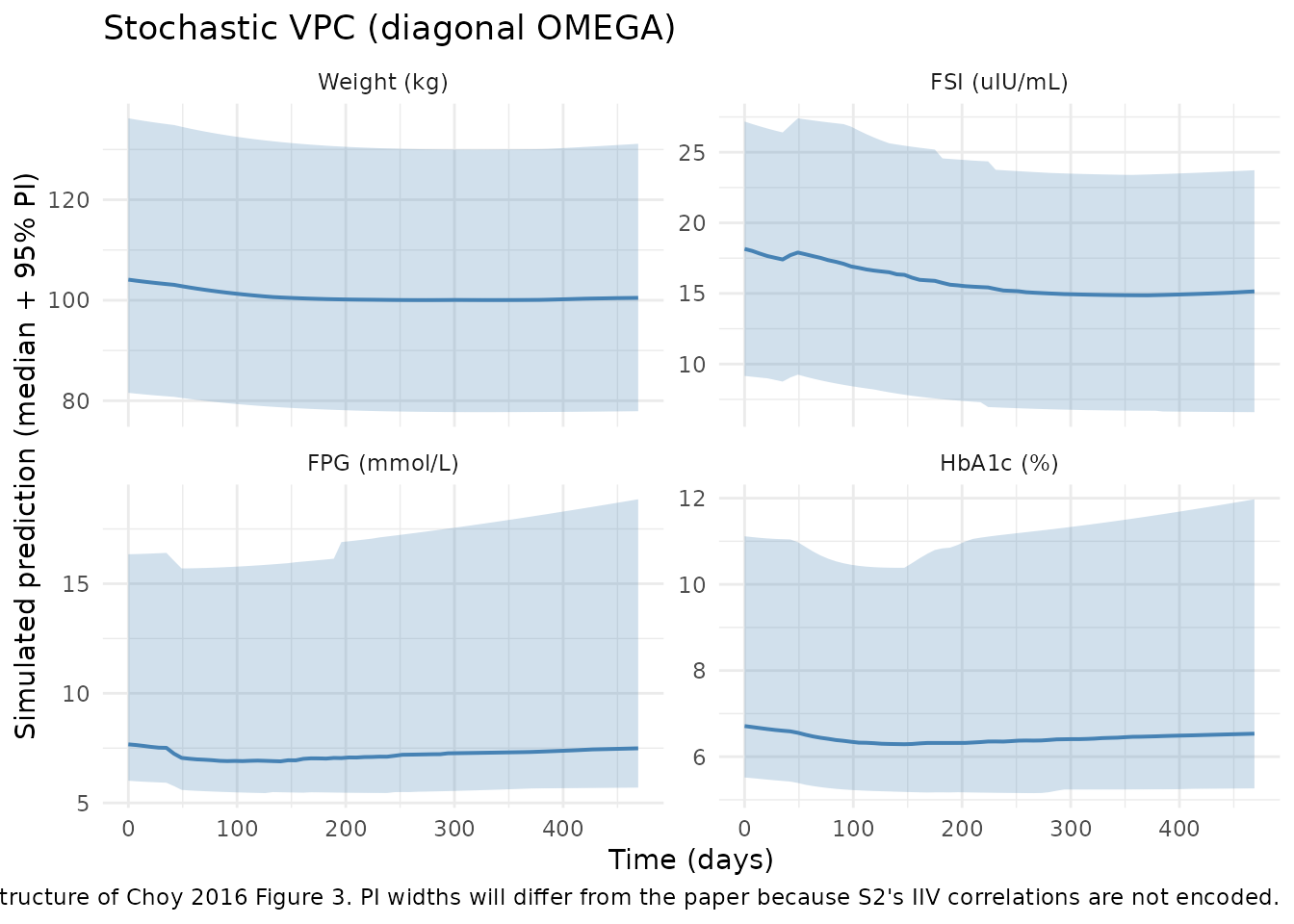
Insulin sensitivity vs weight change (Figure 5)
Choy 2016 Figure 5 plots posthoc estimates of insulin sensitivity
against absolute weight change, with the linear regression
IS_rel = 1 + scaleefs * (-dWGT). The typical-value
relationship is reproduced exactly:
dwgt_grid <- seq(-15, 15, by = 0.5)
is_rel    <- 1 - 0.0514 * dwgt_grid

ggplot(data.frame(dwgt = dwgt_grid, IS_rel = is_rel),
       aes(dwgt, IS_rel)) +
  geom_line(color = "steelblue", linewidth = 0.9) +
  geom_hline(yintercept = 1, linetype = "dashed", color = "grey50") +
  geom_vline(xintercept = 0, linetype = "dashed", color = "grey50") +
  labs(
    x = "Absolute weight change dWGT (kg)",
    y = "Relative insulin sensitivity (EFS)",
    title = "Relative insulin sensitivity vs weight change",
    caption = paste0(
      "Replicates Choy 2016 Figure 5. Slope = -scaleefs = -0.0514/kg; for each ",
      "kilogram lost the typical individual regains ~5.1% relative insulin ",
      "sensitivity (paper text says ~1.5% absolute, which equals 5.1% relative ",
      "of a 25% baseline -- the paper's narrative quotes the absolute change)."
    )
  ) +
  theme_minimal()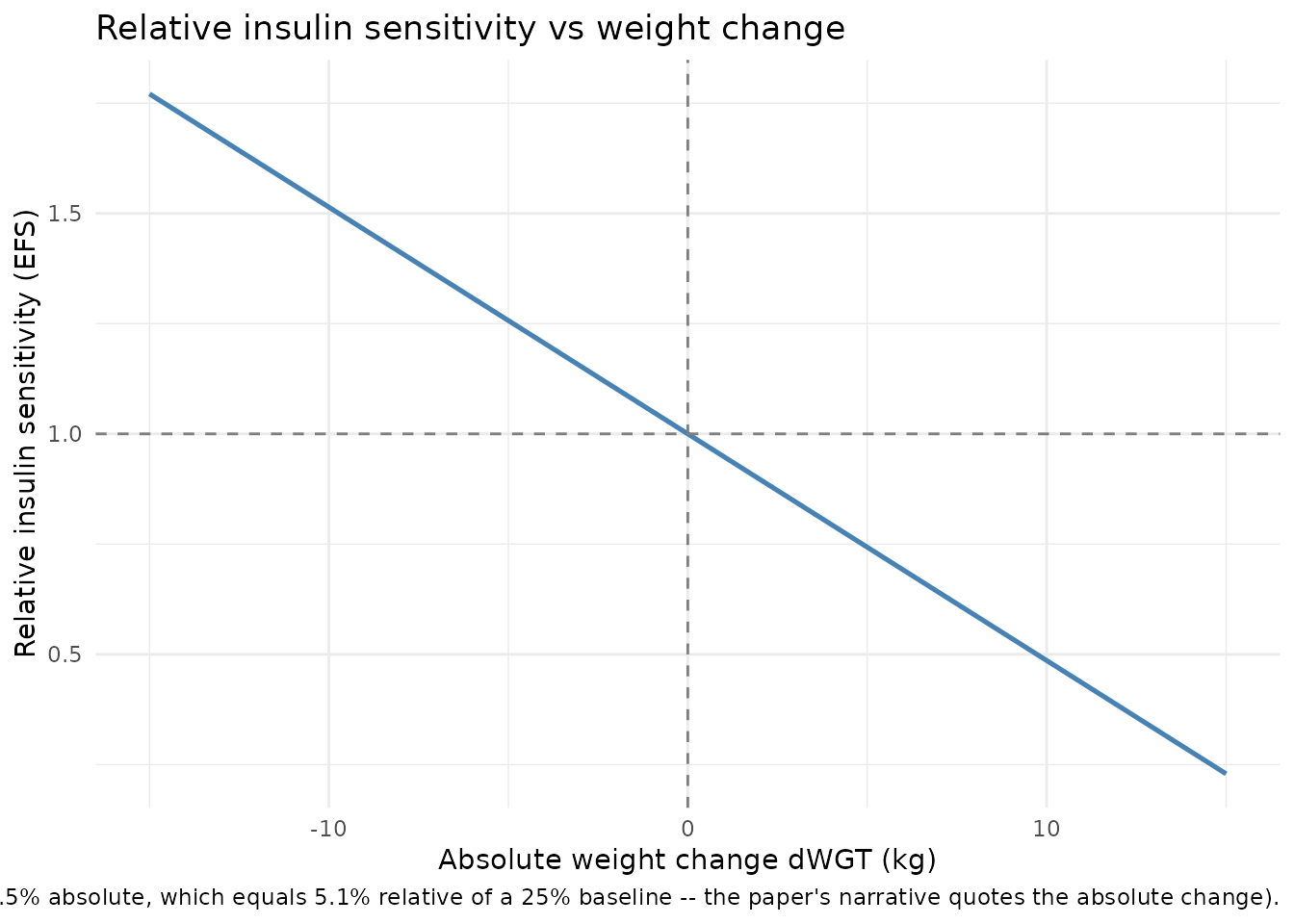
Assumptions and deviations
No NCA / PKNCA validation. The WHIG model has no PK exposure, no dosing, and no concentration-time profile to integrate. The validation strategy follows the endogenous-model pattern: steady-state check, mass-balance / flux check, and dimensional analysis.
Supplementary Appendix S2 not available; diagonal OMEGA. The variance-covariance correlation matrix (Choy 2016, p. 15 footnote a; described in Supplementary Appendix S2) was not available when this model was built. The two supplement PDFs that were available (labelled S1 and S2) are duplicate copies of the main paper (both 9 pages, both report the title page text). The packaged model therefore uses a diagonal OMEGA structure. Simulation reproduces typical-value predictions exactly but cannot exactly reproduce the published 95% prediction-interval widths in Choy 2016 Figures 3 and 4 (which depend on the missing correlations – the paper explicitly notes that the expanded variance-covariance matrix narrows the prediction-interval ribbons; see Discussion paragraph after Figure 6).
Supplementary Appendix S1 not available; FSI-FPG modelled as algebraic QSS. Appendix S1 (the linearisation of FSI production into a quadratic for FPG, paper p. 13) was also not available; however, the QSS quadratic itself is straightforwardly derived from the structural ODEs in Choy 2016 Eq. 10-12 plus the two HOMA constants (
KinFSI/KoutFSI = 7.8,KinFPG/KoutFPG = 35.1). The packaged model encodes the analytic positive root of the FPG quadratic directly inmodel(); FSI follows fromFSI_SS = 7.8 * Beff * (FPG_SS - 3.5).IIV interpretation (Table 1 footnote b). Footnote b states that the CV values for
is0,b0,rb,efde,efp, andefupare “reported as absolute values”. For the logit-scale parameters (is0,b0,rb) the packaged model takes the column entry as the absolute SD on the parameter’s natural scale (variance = SD^2). For the percent-effect parameters (efde,efp,efup) the column entry is interpreted as the absolute SD in percent-points (SD = column / 100, variance = (column / 100)^2); the alternative reading (raw SD value in units of percent) gives biologically implausible variability (e.g., an EFDE SD of 35.6 around a typical EFDE of 4.08 would correspond to a >8-sigma swing in either direction). The chosen reading produces IIV magnitudes consistent with the paper’s stated bootstrap RSEs.Compartment
weightnot in the canonical compartment list. The body-weight state is a biologically obvious compartment that has no canonical analogue in the nlmixr2 convention set (depot,central,peripheral1,peripheral2,effect,target,complex,transit<n>,precursor<n>, …). It is kept asweightfor readability rather than being shoehorned into a generic chain prefix; future inclusion of aweightcompartment inR/conventions.R::registeredCompartmentswould letcheckModelConventions()accept it without a warning.Units schema mismatch.
units$dosing = "n/a (placebo / lifestyle intervention only)"does not share a numerator dimension withunits$concentration = "weight (kg); FSI (uIU/mL); FPG (mmol/L); HbA1c (%)". This is structural: the model has no dosing input and four heterogeneous outputs. The convention lint flags this as a dimensional incompatibility; the warning is expected.Reference time origin. The paper’s “time = 0” is the start of the 6-week placebo run-in (i.e., study enrolment day). The active treatment phase begins at
t = tTRT = 42 days. Users importing data must align their time column to the run-in start, not the active-phase start, for the EFP step to fire at the correct day.Boolean step functions in
model(). The EFP step(t >= tTRT)and the PPG-scale step(t > 0)are evaluated as 1/0 indicators by rxode2 at each integration step. The integrator handles the discontinuity natively but tightly-spaced observation grids neart = tTRTwill resolve the step crispness more sharply than coarser grids.