
Model Linearization for IIV and Residual Error Search
nlmixr2extra authors
2026-09-30
Source:vignettes/articles/model-linearization.Rmd
model-linearization.RmdIntroduction
Fitting a nonlinear mixed-effects (NLME) model for every candidate random-effect or residual-error structure is computationally expensive. Model linearization replaces the nonlinear model with a first-order Taylor expansion around the current individual predictions. The resulting linear model fits in a fraction of the time, allowing exhaustive search over:
-
Inter-individual variability (IIV) structure –
which parameters carry random effects, and which pairs are correlated
(
iivSearch()). -
Residual error model – additive, proportional, or
combined variance structures (
resSearch()).
The workflow has three stages:
- Fit the nonlinear model (any method; at least one ).
-
Linearize the fit (
linearize()). -
Search IIV or residual structure on the linearized
model, then refit the top candidates with the original nonlinear model
(
rerunTopN()).
Theory
The FOCEI objective function at the MAP estimates is:
A first-order Taylor expansion of and (the residual variance) around the population prediction gives:
where and the linearized residual variance is similarly expanded. This is the “FOCE approximation”. Adding the residual-variance gradient gives the full “FOCEI approximation”.
Because the linearized model is itself linear in the parameters, each candidate structure requires only one fast FOCEI fit rather than a full nonlinear optimization.
Simulate data for demonstration
Define a one-compartment model with additive residual error and IIV with correlation between CL and V:
oneCmt <- function() {
  ini({
    tcl <- log(2.7) # Cl
    tv <- log(30) # V
    tka <- log(1.56) #  Ka
    eta.cl + eta.v ~ sd(cor(0.3, 0.99, 0.5))
    eta.ka ~ 0
    add.sd <- 0.7
  })
  model({
    ka <- exp(tka + eta.ka)
    cl <- exp(tcl + eta.cl)
    v <- exp(tv + eta.v)
    d / dt(depot) <- -ka * depot
    d / dt(center) <- ka * depot - cl / v * center
    cp <- center / v
    cp ~ add(add.sd)
  })
  }

set.seed(42)
ev <- rxode2::et(amt = 300, cmt = "depot") |>
  rxode2::et(time = c(0.25, 0.5, 1, 2, 3, 6, 8, 12, 16, 24))
sim <- rxode2::rxSolve(oneCmt, ev, nSub = 50, addDosing = TRUE)
sim$dv <- sim$sim
sim$id <- sim$sim.id
sim <- sim[, c("id", "time", "amt", "dv", "evid")]
Linearizing a fit
Run Linearization
linearize() takes a fitted nlmixr2 object
and returns an nlmixr2Linearize fit.
# addEtas = TRUE adds fixed etas on every theta before linearizing,
# giving derivatives with respect to every parameter.
fitLin := linearize(fit, addEtas = TRUE)
The function:
- If
addEtas = TRUE, adds small fixed etas on all thetas and re-evaluates the model withmaxOuterIterations = 0to extract derivatives. - Builds the linearized model using
linModGen(). - Fits the linear model via FOCEI over a vector of
mcetavalues, stopping when the relative OFV deviation is withinrelTol.
Checking linearization quality
After linearize(), confirm that the linear approximation
reproduces the original model well:
match <- isLinearizeMatch(fitLin)

# OFV agreement (relative tolerance 10%)
match$ofv[[1]]   # TRUE/FALSE if OFV differ by less than tol
#> [1] TRUE
match$ofv[[2]]   # all.equal() message if FALSE
#> [1] TRUE

# Omega matrix agreement
match$omega[[1]]  # TRUE/FALSE if Omega matrices differ by less than tol
#> [1] TRUE

# Individual eta agreement
match$eta[[1]] # TRUE/FALSE if all individual etas differ by less than tol
#> [1] TRUE


# Residual variance agreement
match$err[[1]] # TRUE/FALSE if residual variances differ by less than tol
#> [1] TRUE
A visual check is available via linearizePlot():
linearizePlot(fitLin)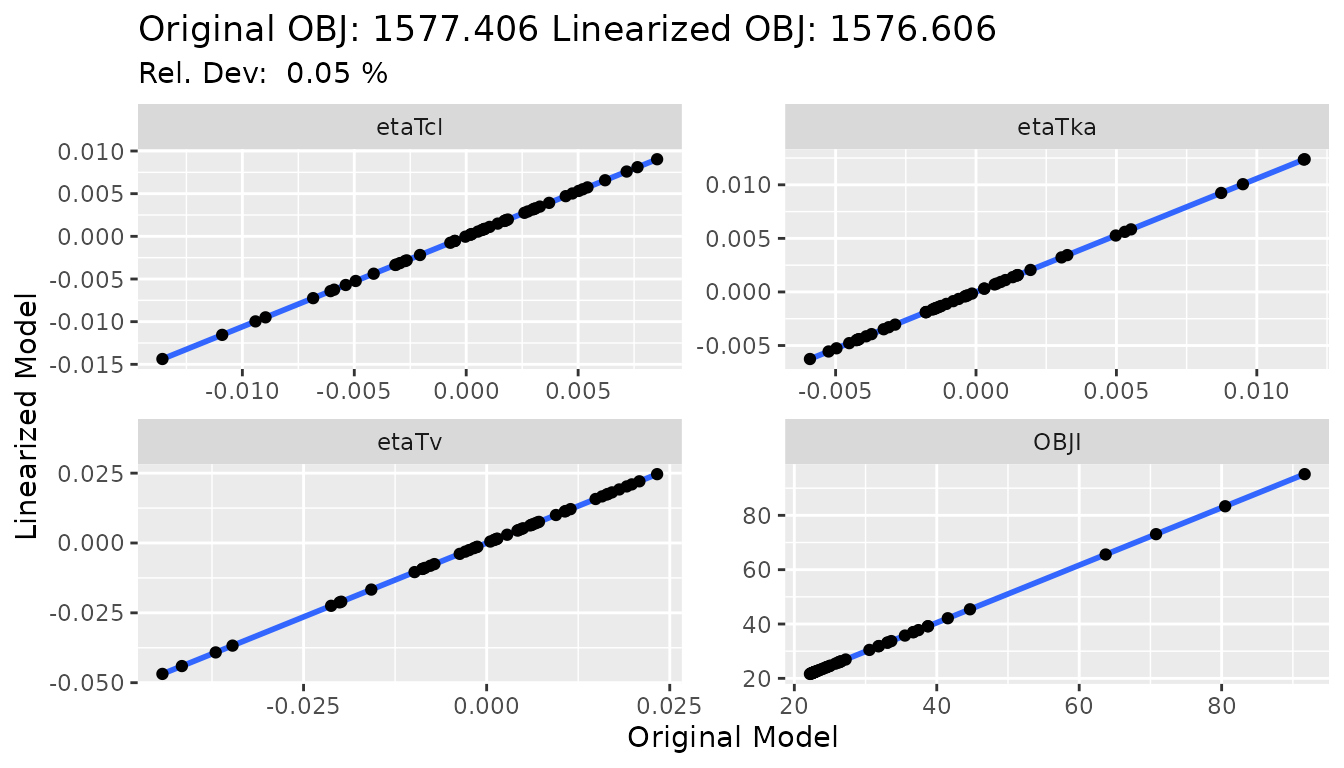
The plot shows original vs. linearized individual objective values and etas. Points should lie on the identity line for a good approximation.
FOCE vs. FOCEI linearization
The focei argument controls whether the
residual-variance gradient is included:
focei |
Description |
|---|---|
NA (default) |
Try FOCEI; switch to FOCE automatically if relTol is
exceeded |
TRUE |
Always use FOCEI (individual + residual linearization) |
FALSE |
Always use FOCE (residual interaction linearization skipped) |
FOCEI is more accurate for models with heteroscedastic residuals (proportional or combined error). FOCE is faster and more stable for additive-only models.
Tuning mceta
The mceta argument is a vector of Monte Carlo eta sample
sizes tried in order. The algorithm stops when the relative OFV
deviation is within relTol:
# Default: try -1, 10, 100, 1000 in order
linearize(fit, addEtas = TRUE, mceta = c(-1, 10, 100, 1000))

# For a difficult model, start with a larger mceta
linearize(fit, addEtas = TRUE, mceta = c(100, 500, 1000))
mceta = -1 uses the exact gradient (no Monte Carlo
sampling) and is the fastest option. Larger values are useful when exact
gradients cause numerical issues.
IIV structure search
Overview
iivSearch() fits every combination of:
- Which thetas carry a random effect (any subset of those present)
- Which pairs of those etas are correlated
For
etas, the number of candidate structures grows as
. For
this is around 64 models; for
it is around 1000. Restrict the search to a manageable number of etas
using addAllEtas() with fix = TRUE to identify
which parameters have meaningful random-effect signal before running the
full search.
Running the search
iivRes := iivSearch(fitLin)Progress is shown for each candidate structure. Failed fits
(non-convergence) are stored as NA in the summary and do
not stop the search.
Examining results
# Print ordered by BIC
print(iivRes)
#>              OBJF      AIC      BIC
#> FOCEi13  476.3687 1409.307 1438.809
#> FOCEi10  514.3502 1443.289 1464.362
#> FOCEi3   553.2211 1478.160 1490.803
#> FOCEi16  531.5302 1464.469 1493.971
#> FOCEi9   553.4991 1480.438 1497.296
#> FOCEi14  604.2598 1537.198 1566.701
#> FOCEi4   647.0378 1573.976 1590.835
#> FOCEi12  646.0224 1574.961 1596.034
#> FOCEi1   800.1752 1723.114 1731.543
#> FOCEi7   800.4129 1725.351 1737.995
#> FOCEi8   800.6373 1727.576 1744.434
#> FOCEi15  815.1749 1748.113 1777.616
#> FOCEi11 1283.8662 2216.805 2246.307
#> FOCEi5  1381.6581 2306.597 2319.240
#> FOCEi2  1493.1602 2416.099 2424.528
#> FOCEi   1549.0857 2472.024 2480.453
#> FOCEi6  1590.7135 2517.652 2534.510
#>                                                              search nParams
#> FOCEi13              etaTcl+etaTv+etaTka+etaTcl~etaTv+etaTcl~etaTka       7
#> FOCEi10                            etaTcl+etaTv+etaTka+etaTcl~etaTv       5
#> FOCEi3                                                etaTcl+etaTv+       3
#> FOCEi16 etaTcl+etaTv+etaTka+etaTcl~etaTv+etaTcl~etaTka+etaTv~etaTka       7
#> FOCEi9                                         etaTcl+etaTv+etaTka+       4
#> FOCEi14               etaTcl+etaTv+etaTka+etaTcl~etaTv+etaTv~etaTka       7
#> FOCEi4                                    etaTcl+etaTv+etaTcl~etaTv       4
#> FOCEi12                            etaTcl+etaTv+etaTka+etaTv~etaTka       5
#> FOCEi1                                                        etaTv       2
#> FOCEi7                                                etaTv+etaTka+       3
#> FOCEi8                                    etaTv+etaTka+etaTv~etaTka       4
#> FOCEi15              etaTcl+etaTv+etaTka+etaTcl~etaTka+etaTv~etaTka       7
#> FOCEi11                           etaTcl+etaTv+etaTka+etaTcl~etaTka       7
#> FOCEi5                                               etaTcl+etaTka+       3
#> FOCEi2                                                       etaTka       2
#> FOCEi                                                        etaTcl       2
#> FOCEi6                                  etaTcl+etaTka+etaTcl~etaTka       4
#>         covMethod outerOptTxt
#> FOCEi13       r,s      bobyqa
#> FOCEi10       r,s      bobyqa
#> FOCEi3        r,s      bobyqa
#> FOCEi16       r,s      bobyqa
#> FOCEi9        r,s      bobyqa
#> FOCEi14       r,s      bobyqa
#> FOCEi4        r,s      bobyqa
#> FOCEi12       r,s      bobyqa
#> FOCEi1        r,s      bobyqa
#> FOCEi7        r,s      bobyqa
#> FOCEi8        r,s      bobyqa
#> FOCEi15       r,s      bobyqa
#> FOCEi11       r,s      bobyqa
#> FOCEi5        r,s      bobyqa
#> FOCEi2        r,s      bobyqa
#> FOCEi         r,s      bobyqa
#> FOCEi6        r,s      bobyqa

# The summary data frame
head(iivRes$summary[order(iivRes$summary$BIC), ])
#>             OBJF      AIC      BIC
#> FOCEi13 476.3687 1409.307 1438.809
#> FOCEi10 514.3502 1443.289 1464.362
#> FOCEi3  553.2211 1478.160 1490.803
#> FOCEi16 531.5302 1464.469 1493.971
#> FOCEi9  553.4991 1480.438 1497.296
#> FOCEi14 604.2598 1537.198 1566.701
#>                                                              search nParams
#> FOCEi13              etaTcl+etaTv+etaTka+etaTcl~etaTv+etaTcl~etaTka       7
#> FOCEi10                            etaTcl+etaTv+etaTka+etaTcl~etaTv       5
#> FOCEi3                                                etaTcl+etaTv+       3
#> FOCEi16 etaTcl+etaTv+etaTka+etaTcl~etaTv+etaTcl~etaTka+etaTv~etaTka       7
#> FOCEi9                                         etaTcl+etaTv+etaTka+       4
#> FOCEi14               etaTcl+etaTv+etaTka+etaTcl~etaTv+etaTv~etaTka       7
#>         covMethod outerOptTxt
#> FOCEi13       r,s      bobyqa
#> FOCEi10       r,s      bobyqa
#> FOCEi3        r,s      bobyqa
#> FOCEi16       r,s      bobyqa
#> FOCEi9        r,s      bobyqa
#> FOCEi14       r,s      bobyqa
The summary contains one row per candidate with columns:
| Column | Description |
|---|---|
OBJF |
Objective function value |
AIC |
Akaike information criterion |
BIC |
Bayesian information criterion |
search |
Structure string (see below) |
nParams |
Number of estimated parameters |
covMethod |
Covariance method ("r,s" = success) |
Refitting top candidates with the original model
The linearized results are used to rank candidates, but final
inference should be based on the original nonlinear model.
rerunTopN() refits the top n structures:
# Refit the 5 best structures with the original nonlinear model
top5 := rerunTopN(iivRes, n = 5)

# Results ordered by BIC from the nonlinear fits
top5$summary[order(top5$summary$O.BIC), ]
#>           O.OBJF    O.AIC    O.BIC O.Log-likelihood O.Condition#(Cov)
#> FOCEi   732.0524 1660.991 1682.064        -825.4955          36.31759
#> FOCEi1  733.1991 1664.138 1689.425        -826.0688         493.45679
#> FOCEi3  847.7564 1786.695 1828.841        -883.3475        1603.52853
#> FOCEi2  909.8071 1842.746 1872.248        -914.3728          63.81725
#> FOCEi4 1083.3590 2022.298 2064.444       -1001.1488          63.96851
#>        O.Condition#(Cor)                                         search
#> FOCEi           28.18692                                          etaTv
#> FOCEi1          31.95320                                  etaTv+etaTka+
#> FOCEi3        1395.26707 etaTcl+etaTv+etaTka+etaTcl~etaTka+etaTv~etaTka
#> FOCEi2          18.60369                      etaTv+etaTka+etaTv~etaTka
#> FOCEi4          15.21032              etaTcl+etaTv+etaTka+etaTcl~etaTka
The summary column names are prefixed with O. (for
“original”) to distinguish them from the linearized model results.
Visualising the IIV search
summ <- iivRes$summary
summ <- summ[!is.na(summ$BIC), ]
summ$rank <- rank(summ$BIC)

ggplot(summ, aes(x = rank, y = BIC - min(BIC))) +
  geom_point(aes(colour = covMethod == "r,s"), size = 2) +
  scale_colour_manual(values = c("TRUE" = "steelblue", "FALSE" = "tomato"),
                      name = "Converged") +
  labs(x = "BIC rank", y = expression(Delta * "BIC"),
       title = "IIV search: BIC relative to best model") +
  theme_bw()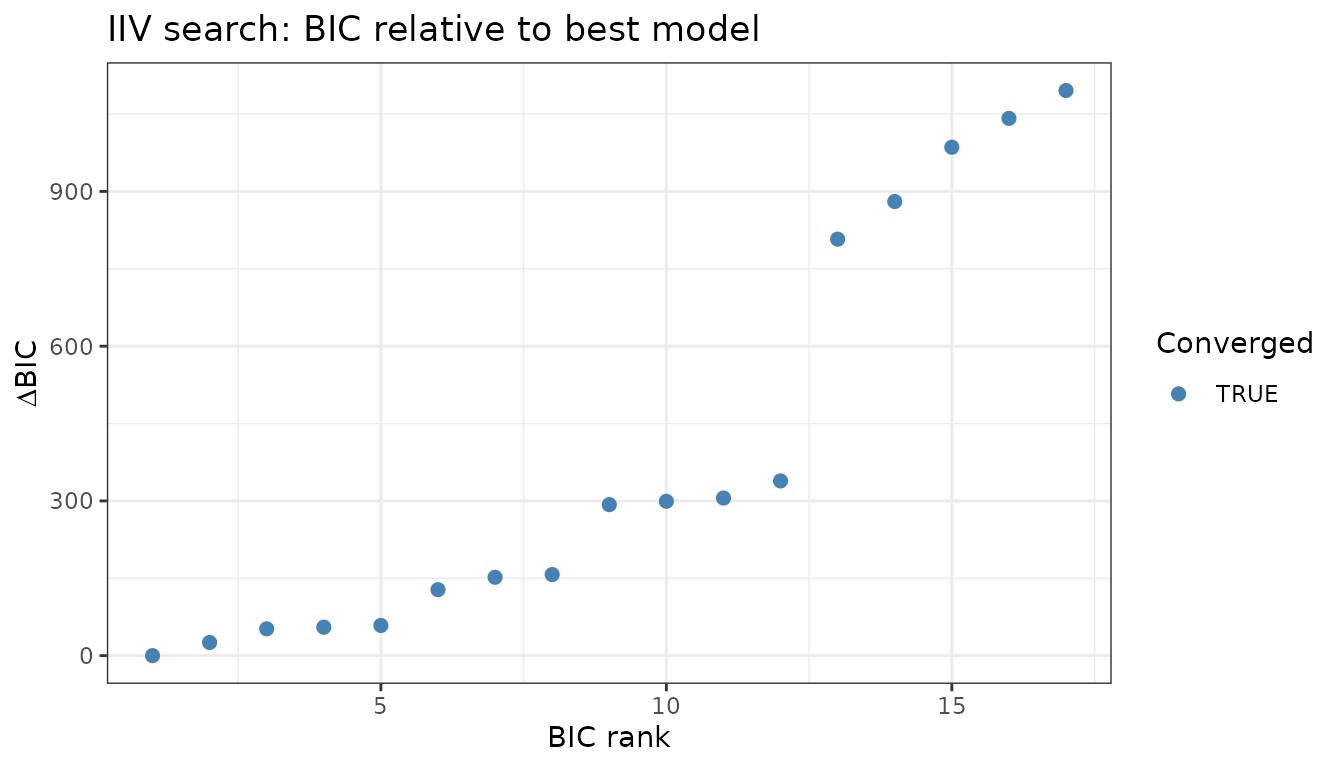
Residual error model search
resSearch() tests three alternative residual structures
on a linearized fit and returns their OFV, AIC, and BIC for
comparison.
The structures tested are:
| Name |
rxR2 formula |
|---|---|
| Base fit | (whatever was in the linearized model) |
| Proportional | prop.sd^2 * OPRED^2 |
| Combined (type 2) | prop.sd^2 * OPRED^2 + add.sd^2 |
| Combined (type 1) | (prop.sd * OPRED + add.sd)^2 |
# Start from a linearized model; additive-only in this case
fitLinAdd := linearize(fit, addEtas = TRUE)

isLinearizeMatch(fitLinAdd)  # check quality before searching
#> $ofv
#> $ofv[[1]]
#> [1] TRUE
#>
#> $ofv[[2]]
#> [1] TRUE
#>
#>
#> $omega
#> $omega[[1]]
#> [1] TRUE
#>
#> $omega[[2]]
#> [1] TRUE
#>
#>
#> $eta
#> $eta[[1]]
#> [1] TRUE
#>
#> $eta[[2]]
#> [1] TRUE
#>
#>
#> $err
#> $err[[1]]
#> [1] TRUE
#>
#> $err[[2]]
#> [1] TRUE

resRes := resSearch(fitLinAdd)

# Compare by BIC
resRes$summary[order(resRes$summary$BIC), ]
#>            OBJF      AIC      BIC    search
#> FOCEi1 1315.987 2236.926 2241.140      prop
#> FOCEi2 1525.454 2448.393 2456.822 combined2
#> FOCEi3 1548.200 2471.139 2479.568 combined1
#> FOCEi  1576.606 2497.544 2501.759  base fit
The returned list also includes resRes$originalFit (the
linearized fit used as the base) for reference.
Full workflow example
## 1. Fit the base nonlinear model (no IIV, additive error)
fit <- nlmixr2(oneCmtBase, sim, est = "focei")

## 2. Linearize, adding etas on all thetas
fitLin <- linearize(fit, addEtas = TRUE, focei = NA)

## 3. Check linearization quality
match <- isLinearizeMatch(fitLin)
stopifnot(match$ofv[[1]])   # abort if linearization is poor

## 4. Search IIV structure
iivRes <- iivSearch(fitLin)
print(iivRes)   # BIC-ordered summary

## 5. Refit top 3 structures with the original model
top3 <- rerunTopN(iivRes, n = 3)
bestStructure <- top3$summary$search[which.min(top3$summary$O.BIC)]
cat("Best IIV structure:", bestStructure, "\n")

## 6. Rebuild the model with the best IIV structure and search residual error
# (refit with the chosen IIV structure first)
# ...then:
resRes <- resSearch(fitLin)
resRes$summary[order(resRes$summary$BIC), ]
Tips and troubleshooting
Linearization fails to converge (relTol
exceeded)
- Try larger
mcetavalues:mceta = c(100, 500, 2000). - Switch to
focei = FALSE(FOCE) which is more numerically stable. - Increase
relTolslightly (e.g.0.30) for a looser quality threshold.
iivSearch produces many NA
entries
Non-convergence is common for small or degenerate IIV structures.
NA rows are skipped in ranking; they do not indicate a bug.
If more than half the search fails, check whether the starting eta
estimates (from the linearized fit) are reasonable.
isLinearizeMatch fails for omegas
The omega matrix comparison uses the MAP estimates from the
linearized fit. Small discrepancies in variance components are expected;
a tolerance of 20% (tol = 0.20) is often appropriate for
omega terms.
rerunTopN is slow
Each of the n calls to nlmixr2() is a full
nonlinear fit. To reduce runtime, use a coarser
foceiControl() (e.g. fewer inner iterations) inside
rerunTopN() for screening, then do a clean final fit on the
selected structure.